

Croatian Word of the Week:
No Hebrew this week - we’re switching it up with the Croatian word for Jewish, which is Židovski, pronounced ZHEE-dohv-skee.
📅Shabbat Drop-In
Exciting announcement! I am co-leading the NYC chapter of Sword of Iron! So if you want to volunteer for Israel and meet like-minded people, message/email me and I’ll send you the form to fill out to join. We’ll be meeting once a month to do good together! ❤️
Zdravo!
Phil and I were just in Croatia for 10 days. Started out in Zagreb, then we drove over to the coast and went city and island hopping.
I didn’t expect this trip to be that Jewish, especially when I was making Shabbos plans in preparation for it. I was told by one synagogue that they only have services for the High Holidays, while another told me they’re closed for summer break. Off to a good start…
Then, during one of our meals on the trip, our appetizer was served, unbeknownst to us, plated on a makeshift communion wafer. “It’s to receive blessings!” the server said gleefully. I needed all the blessings I can get, so I still ate it, but felt weird about it. Plus, it was one of those tiny Michelin-star plates, so I didn’t have an ounce to waste.
Then there was this waiting for me at the top of a hike:
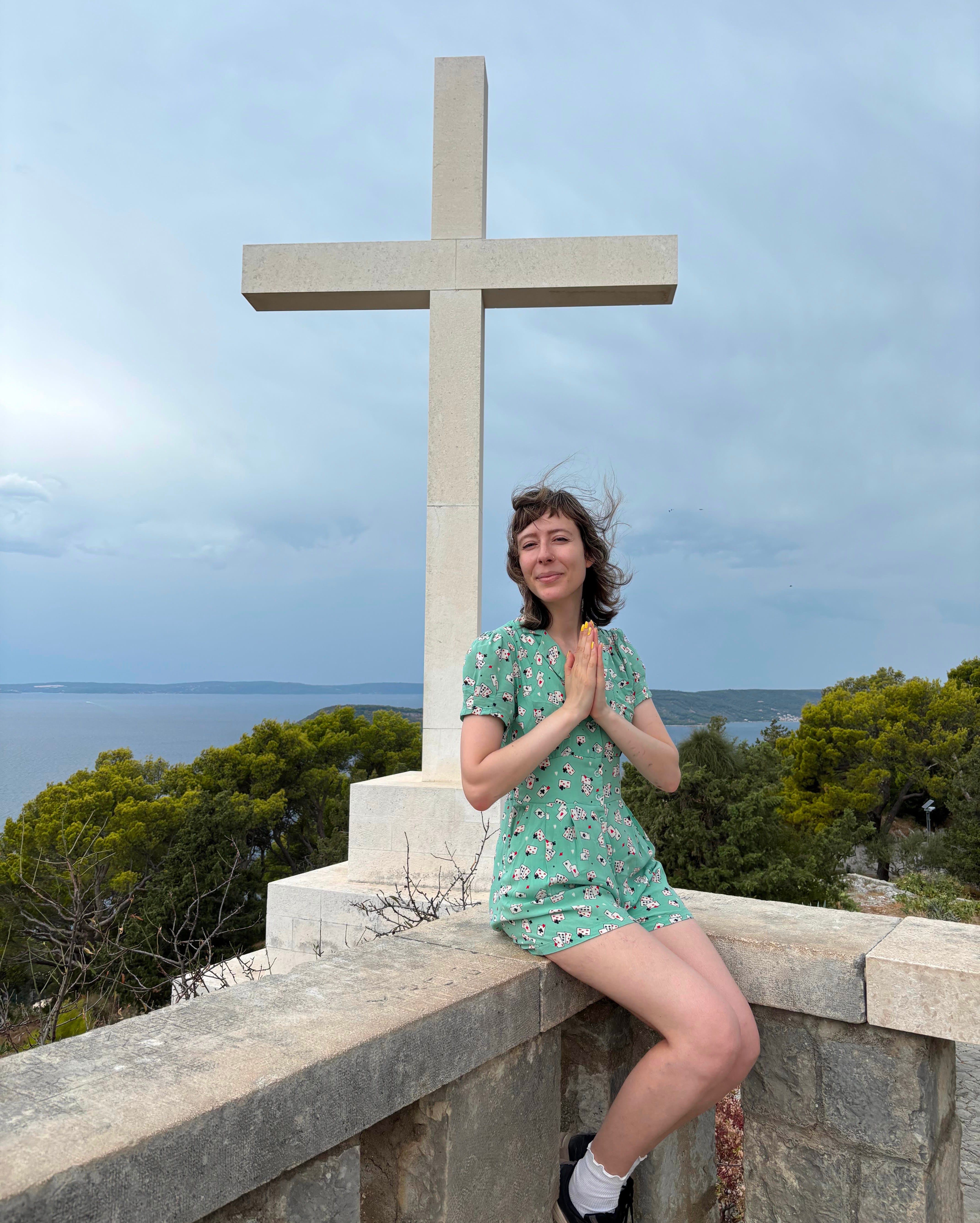
None of this was a surprise to me, given that there are only about 2,000 Jews in a predominantly Catholic country.
But what I didn’t expect was the magnificence of Croatia’s few Jewish sites, some of which we stumbled upon by accident, and the positive encounters we had with non-Jewish tourists there. Welcome to Jewish Croatia!
An overview of Croatian Jewish history
Jews were living in Salona (modern-day Solin, Croatia), the capital of the Roman province of Dalmatia, from roughly the 2nd to the 4th century C.E. It wasn’t until the 7th century, when Salona was destroyed by Avar and Slavic tribes, that Jews fled to Split and sought refuge in what was left of Diocletian’s Palace, which became the city center.
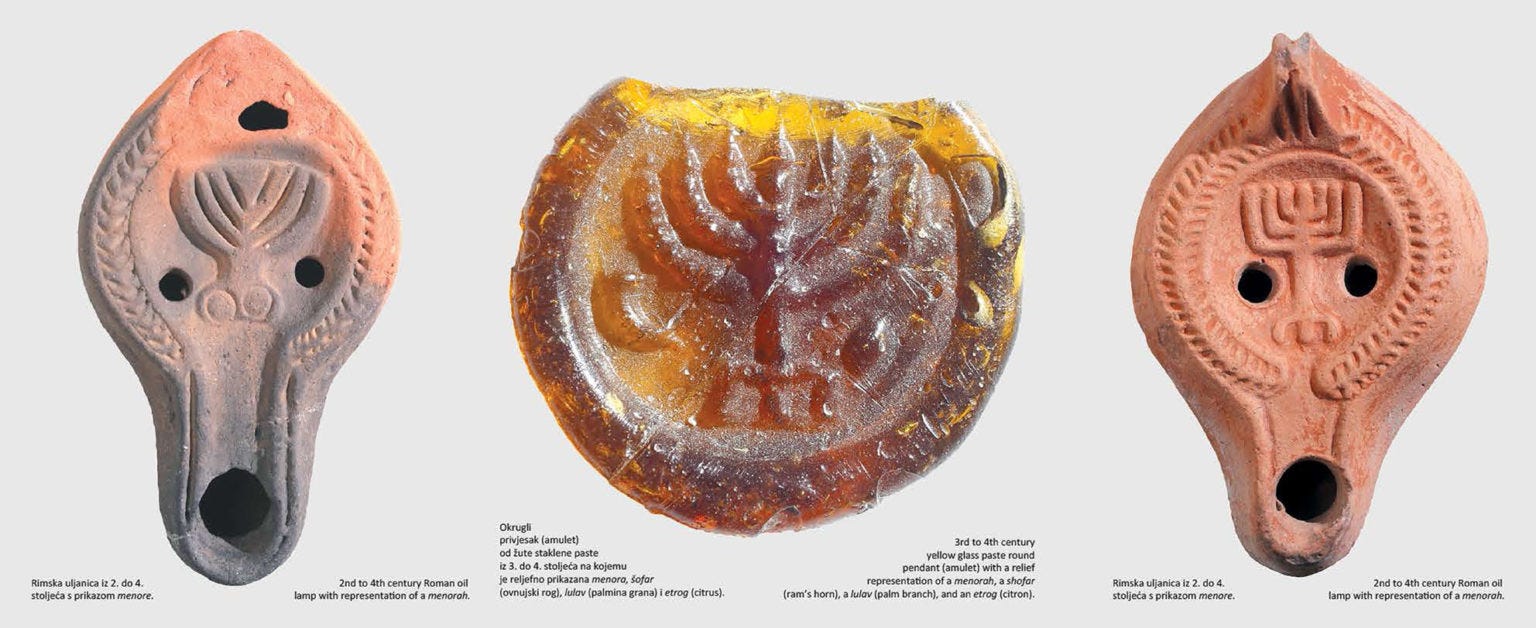
There, Jews became merchants, traders, and doctors in two important coastal cities - Split and Dubrovnik - which we’ll read about shortly.
15th-century persecution brought Jews from Spain, Portugal, and Italy to Croatia, where they established communities with synagogues and cemeteries. Under Venetian rule (15th-18th centuries), the two Jewish groups were known as Ponentini, the westerners, and Levantini, those from the Ottoman east.
🏆Croatian Jew Award🏆
You never thought there was such an award, did you?! This award goes to Daniel Rodriguez (Danijel Rodrigo), a 16th-century Sephardic Jewish merchant.
He became an important figure in Split’s trade, and successfully advocated for Split to become a free port. This helped boost commerce and made Split a major trade hub among the Adriatic Sea, Venice, and the Ottoman Empire.
Then, of course, came the Holocaust. Okay, we may skipping some history here, but I’m touching on major events. In 1941, Axis powers invaded Yugoslavia, which soon collapsed. The fascist Ustaša movement established the Independent State of Croatia, backed by Germany and Italy.
Under this movement, Jews faced antisemitic laws, confiscation of their property, and eventually deportation and murder.
In Zagreb, we were surprised to come across a stumbling stone. We found the stone - my first stumbling stone sighting - walking back from an unsuccessful search for the synagogue. The brass plaque commemorated Lea Deutsch, a child actress known as Croatia’s Shirley Temple, who was taken from her home in May 1943 and died in transport to Auschwitz at the age of 16. Imagine all she could have accomplished with the rest of her life. May her memory be a blessing.


Italy occupied the coast, where Jews had a somewhat different and less severe experience. Italian authorities burned synagogues and all sacred objects inside them, but they generally pushed back against German demands to deport Jews from the territories they occupied. Some Jews actually fled to Italian-controlled areas for safety. After Italy surrendered in September 1943, Germany occupied those territories too, enforcing their stricter policies.
![Ustasa (Croatian fascist) guards force a prisoner into a pit to be shot. [LCID: 78512]](https://substackcdn.com/image/fetch/$s_!YIbE!,f_auto,q_auto:good,fl_progressive:steep/https%3A%2F%2Fsubstack-post-media.s3.amazonaws.com%2Fpublic%2Fimages%2Fc0ac841d-fa06-4efa-80f3-1f8a033e4847_800x529.jpeg "Ustasa (Croatian fascist) guards force a prisoner into a pit to be shot. [LCID: 78512]")
About 80% of Croatia’s Jews (around 30,000) perished in the Holocaust.
Today, there are about 2,000 Jews living in Croatia. While Croatia has rich Sephardic history, today’s Jews are predominantly Ashkenazi.
A Jewish tour of Split and Dubronvik
Split
I mentioned Jews took refuge in Diocletian’s Palace, which we visited. The museum said masons at the time carved their religious symbols into the stone, such as menorahs and crosses! Unfortunately, we didn’t spot any carvings in the light stone. It’s too bad our buddy, Shlomo the Freemason, wasn’t there - maybe he could have spotted a historical mason mark!
The Split synagogue was built in the 16th century directly into the western wall of Diocletian's Palace. It’s located in two medieval houses in Split’s former ghetto, which was one small passage called Židovski prolaz (Jewish Lane).
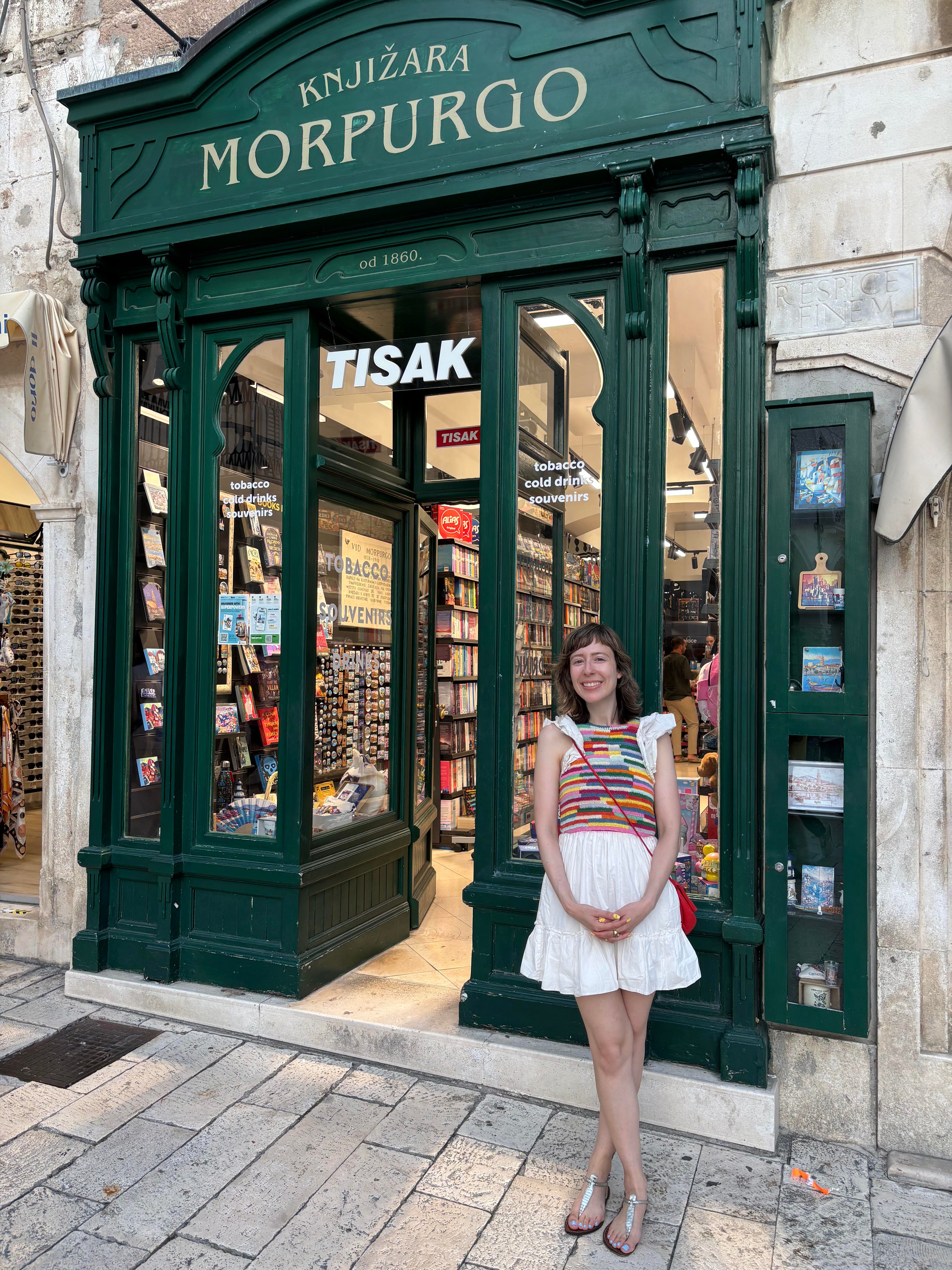
Just down the street from Jewish Lane is the Morpurgo Bookstore. Opened in 1860 by Vid Morpurgo, a prominent Jewish publisher and politician, it survived the Holocaust, when fascists were burning many books and buildings in the area.
Today, it remains one of the oldest operating bookstores in Europe. And I’m happy to report it sells romantasy books, not to mention Noa Tishby’s book on Israel (in Croatian, no less!).
Phil and I then wandered into Marjan Forest Park for a lovely day of walking, when I noticed there was a Jewish cemetery on the map! The Old Jewish Cemetery, established in 1573, has about 700 tombstones overlooking the Adriatic from a sloping hill. It’s the most beautiful Jewish cemetery I’ve ever been to.
And probably the most memorable, for we had a positive interaction there!
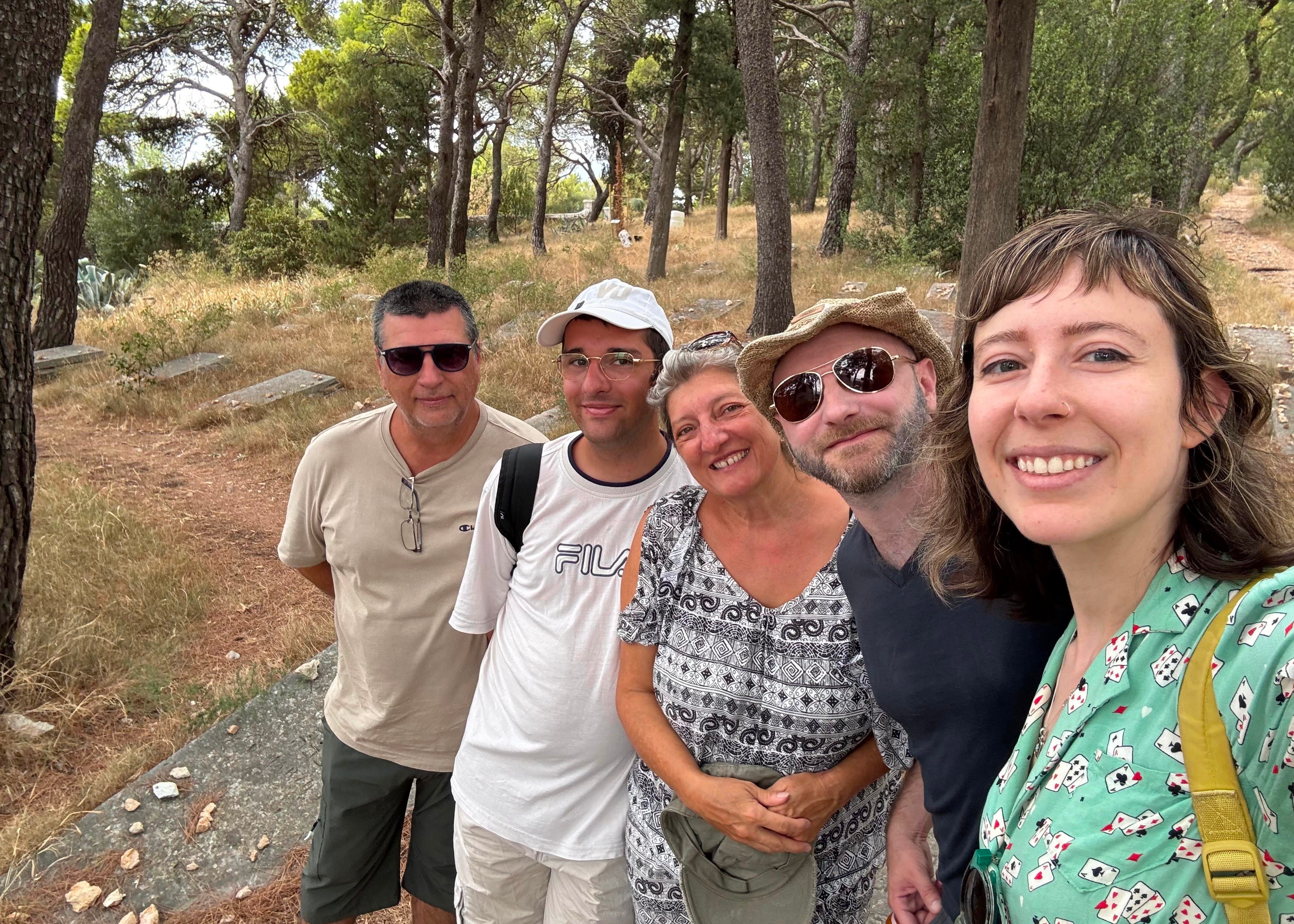
As soon as we entered the cemetery, we saw a family - two parents and their son - place stones on two prominent tombstones near the entrance. I asked if they knew who was buried there.
They said no, and kindly explained it’s Jewish custom to place stones on graves to honor the dead. Phil and I politely smiled as this family explained Jewish custom to us.
Then, they asked if we were Jewish, and I proudly said yes. I felt safe to do so - surely someone who hates Jews wouldn’t spend a gorgeous day hanging out in a cemetery.
They explained they’re Evangelicals from France, and wanted to pay their respects because they know how important it is to never forget what happened to Jews during the Holocaust.
We ended up talking with them for quite some time about Holocaust education in France, antisemitism in both France and the U.S., and politics. Midway through the conversation, I noticed we were talking about these Jewish topics over the graves of Jews who died in 1900. After everything this local community had faced over the centuries, Jews were still here, and so were people who cared enough to honor their memories.
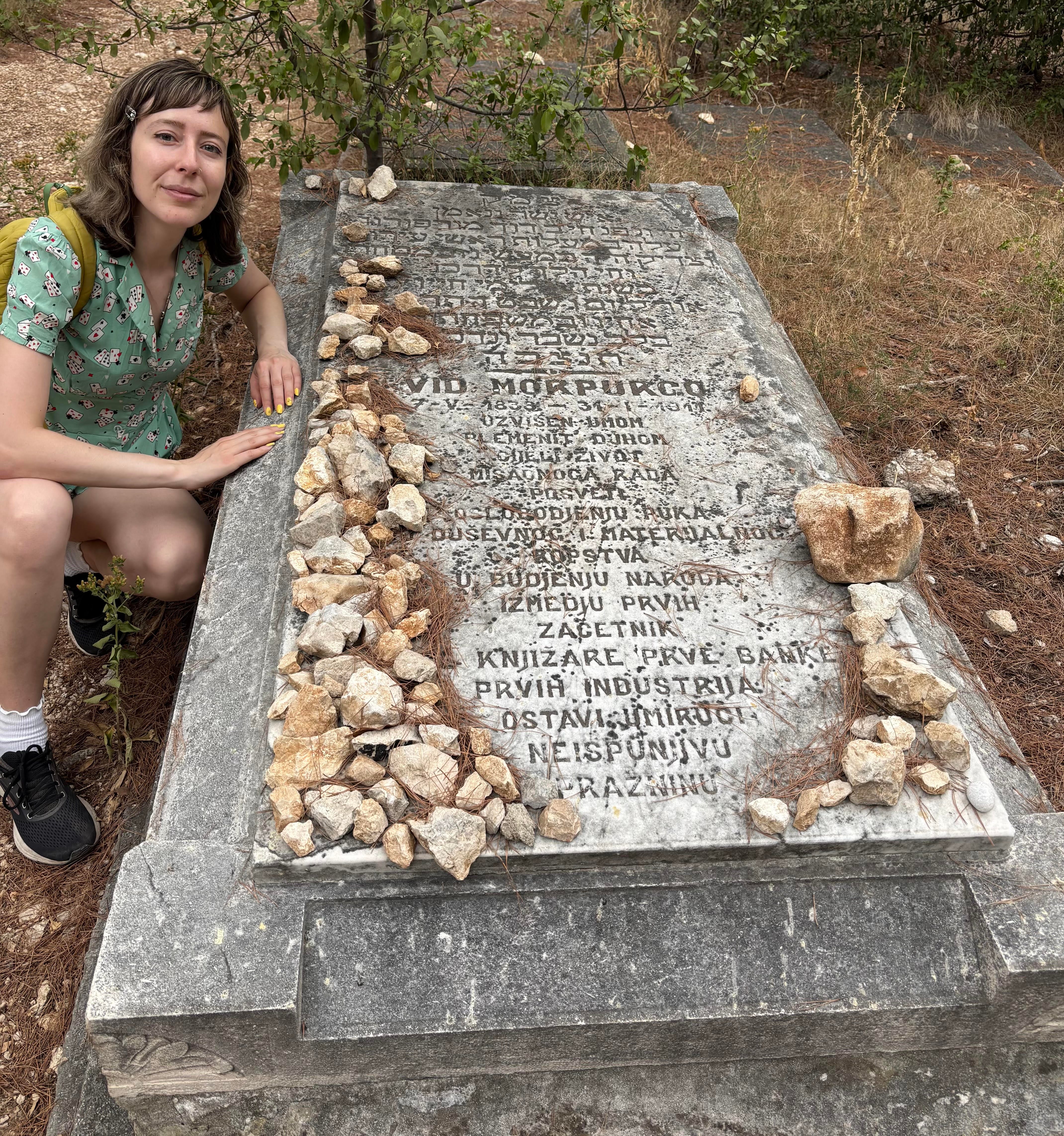
Speaking of honoring memories, we came across the gravesite of bookstore owner Vid Morpurgo (1838-1911), and paid our respects.
I found a translation of his gravestone inscription:
Exalted in mind, noble in spirit, all his life of intellectual work he dedicated to people’s liberation from spiritual and material slavery, and in awakening of people. Founder of the first bookstore, first bank, first factories, left unfillable emptiness when died.
Dubrovnik
About 150 miles down the coastline from Split is Dubrovnik, a medieval, fortified city right on the water, known for its Game of Thrones filming locations.
But what’s even more impressive is its enduring Jewish presence, dating back to 1368, with documentation of Jewish merchants.
In 1538, the government allowed its 250 Jews to settle within the city walls (so generous of them). Then in 1546, dozens of Jews were confined to a ghetto, located on “Jewish Street” near the city center. The ghetto’s conditions weren’t nearly as bad as other European ghettos; Jews could come and go freely throughout the day, but the gates were locked at night.
We visited Jewish Street, which is today lined with restaurants serving all kinds of pork. Go figure.


Unlike the synagogue in Split, you can tour the Dubrovnik Synagogue on Jewish Street. Known as the Old Synagogue, as it was built in 1547, it is the oldest Sephardic synagogue still in use today in the world and the second oldest synagogue in Europe.
You can view the Baroque-styled sanctuary, restored after a 1667 earthquake, and used for High Holiday services. They also have a small museum, which features three Spanish and Italian Torah scrolls dating back to the 16th century which were buried during the Holocaust in a nearby village. I tried to take to take a picture but the lady scolded me :(
Later, while waiting for an Uber on a corner outside of the Old City, I turned around and was shocked at the Hebrew letters on a sign. Phil speculated that it was a cemetery. As usual, he was right.
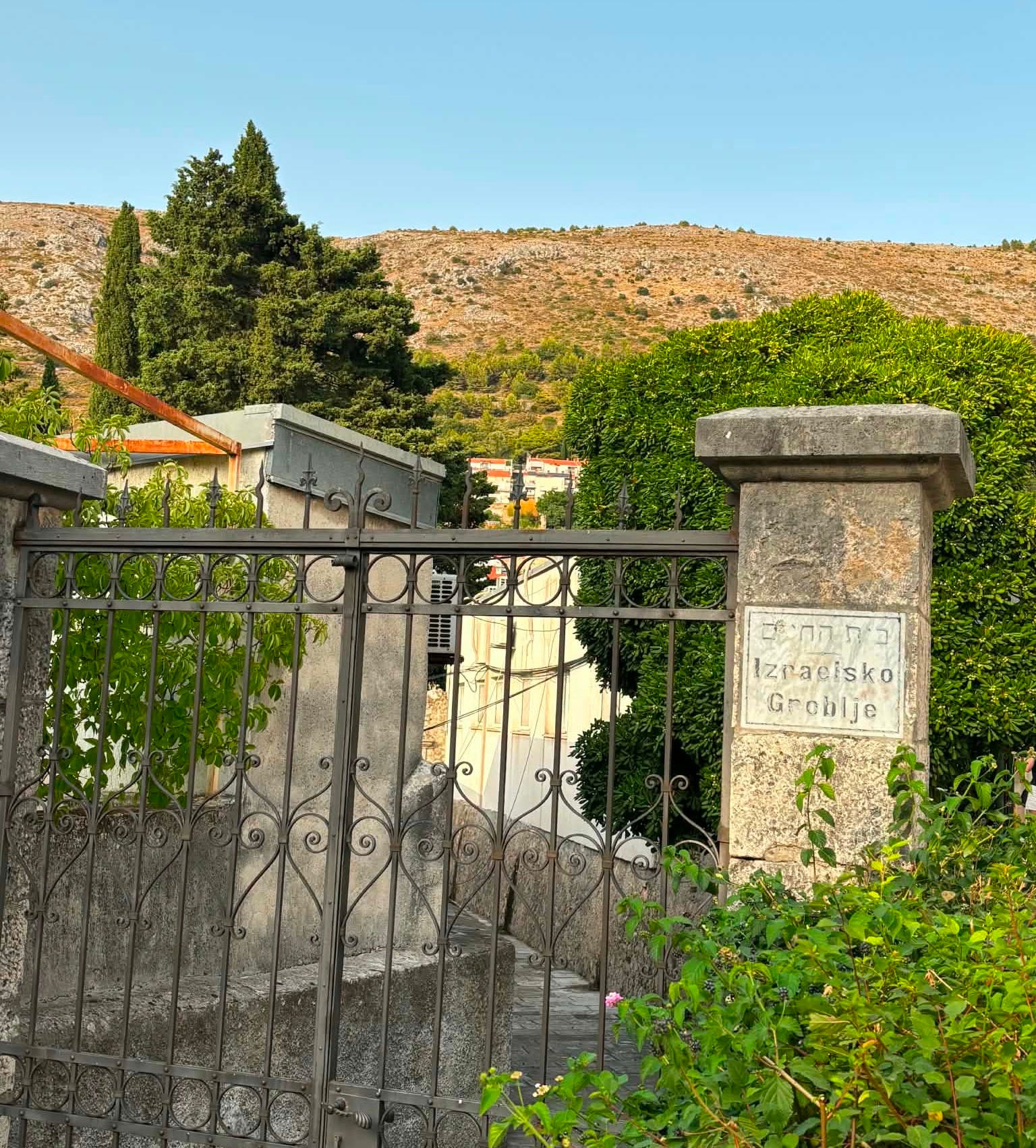
Upon further research, this was the site of the Dubrovnik Old (everything is old) Jewish Cemetery, built in 1652. Today, it is a fire station, but 30 of the original tombstones remain. One tombstone, from 1745, is used for the floor of the fire station.
Conclusion
I didn’t come to this beautiful country for its Jewish history, nor to experience its local community, like I sometimes do on my travels. But of course, I couldn’t help myself in learning about it and seeking it out.
Croatia’s Jewish past echoes the tragic European history we know all too well. It even had its own famous case of blood libel I didn’t mention. But its community achieved successes, some of which can be seen today. Though its Jewish population is small and largely inactive, its preserved history is worth seeing, a testament to the enduring spirit of the Jews who once lived there. Just don’t come expecting Shabbat plans!
Bonus Story 👀
While drinking spritzes atop a 14th-century tower on Korčula, we became friendly with a man from former Yugoslavia, present-day Bosnia. He was telling us how his family fled to Germany when he was five years old.
After buying us rounds of shots, he started showing us his many tattoos, from "As-salamu alaykum" in Arabic to some countries he’s visited.
As he lifted his shorts to show us his inked travel history, my eyes immediately went to a familiar country outline.
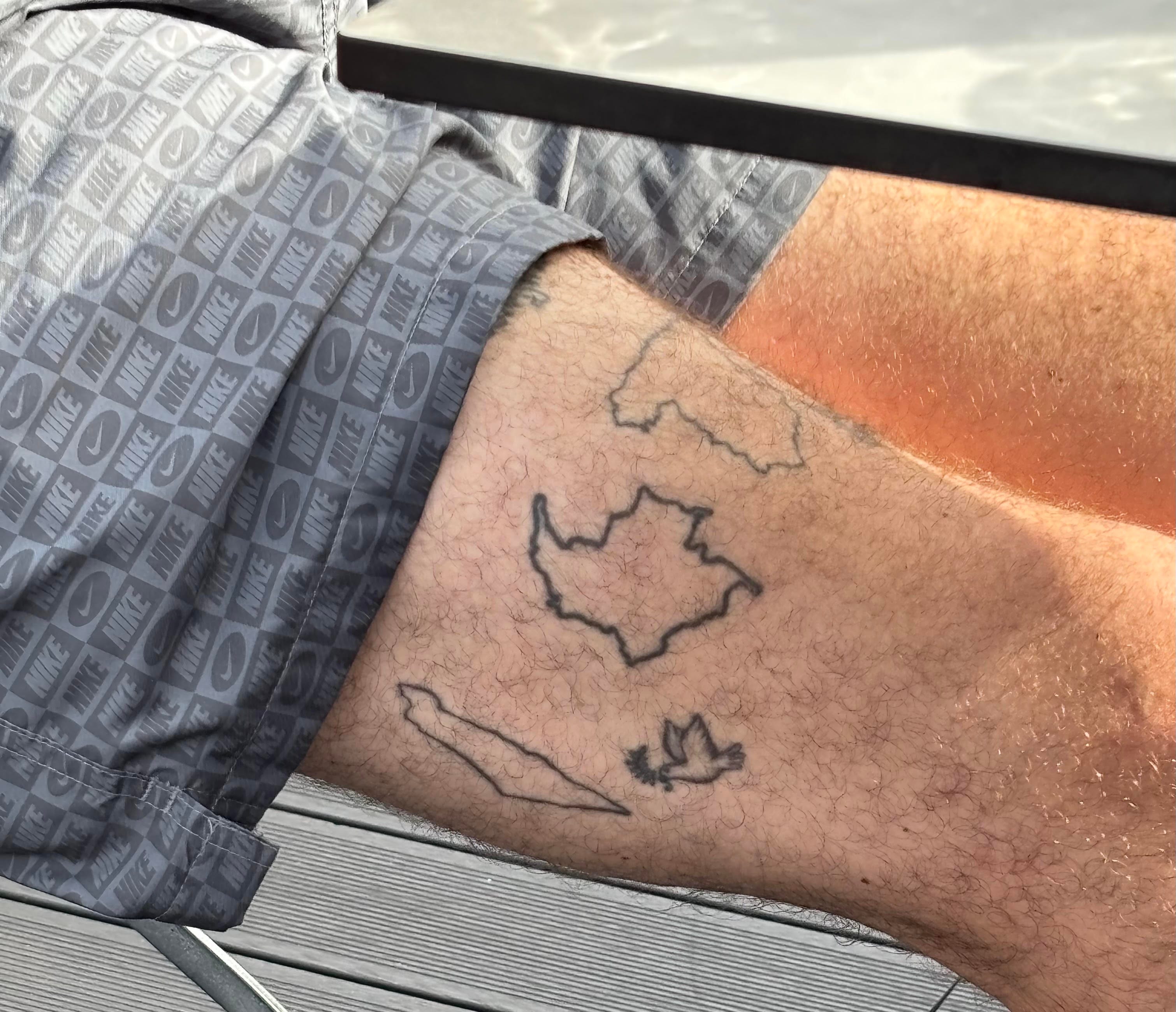
“Ooh, boy, here we go,” I thought. My vacation-induced, lavender-spritz buzz began to fade as I prepared myself for defense mode. I didn’t want a repeat of my Iceland story, when someone told me they boycotted Eurovision because of Israel and I said nothing.
“And this is Israel!” he pointed to his tattoo proudly. “I lived in Tel Aviv for a time.”
Well, that was quite a surprise. He told us he worked for a company that made jet parts and was assisting Israel.
When we told him that outline could represent Palestine for some people, he rolled his eyes and was having none of it. A part of me wondered if he had this strong reaction because he had experienced the realities of war firsthand, instead of learning from news headlines. A different war, but still.
Phil told him stories of living in Israel during the Second Intifada. This interaction was a reminder of the importance of listening to firsthand perspectives, and that you can find allies in the most unexpected places.
“There’s a dove next to Israel for peace,” he said with hope. May it be so.
Shabbos!

Further Reading
Sephardic Jews of Croatia: Dubrovnik, Split, and the Dalmatian Coast
Dubrovnik’s question: Does a synagogue need Jews
💦 If you like Jewish travel, check out these Drops:
A Torah in Tallinn: My Trip to Jewish Estonia

I visited Estonia on a Jewish trip with JDC Entwine! There, I met a thriving community, building itself up after devastating historical events. We visited a Jewish school, a "sünagoog," the Baltic Jewish Network, and a site affected by the Holocaust which is now a hipster hang.
Kosher reindeer, anyone?

My Jewish trip to Finland! Which is, unsurprisingly, not that Jewish. But they have kosher reindeer!
Learned so much about Croatia thanks to a combination of Miranda’s inquisitive mind, keen observations, deep dive into history and breezy way of pulling it all together.
Wow Miranda, you really hit this one out of the park. Thank you so much for this deep dive into all this little-known history. I'm a bit nerdy about Jewish history/culture in general and I never knew any of this before. Kol hakavod!