

Word of the Week:
In lieu of a Hebrew word this week, we’re learning an English word! And that’s mnemohistory, or the study of the past not as it actually happened, but as it is remembered, transmitted, and reinterpreted by societies over time.1
During Covid, my girlfriends and I ran a Torah book club (“Torah Talk”), where we met at the end of each of the Five Books, chumashim and masks in tow. We discussed questions related to the themes of the parshiyot, but couldn’t get past our questions about the plot, like:
How did Jacob not realize he accidentally married Leah instead of Rachel?
Why is G-d being so cruel to the Israelites?
What’s with the talking donkey?
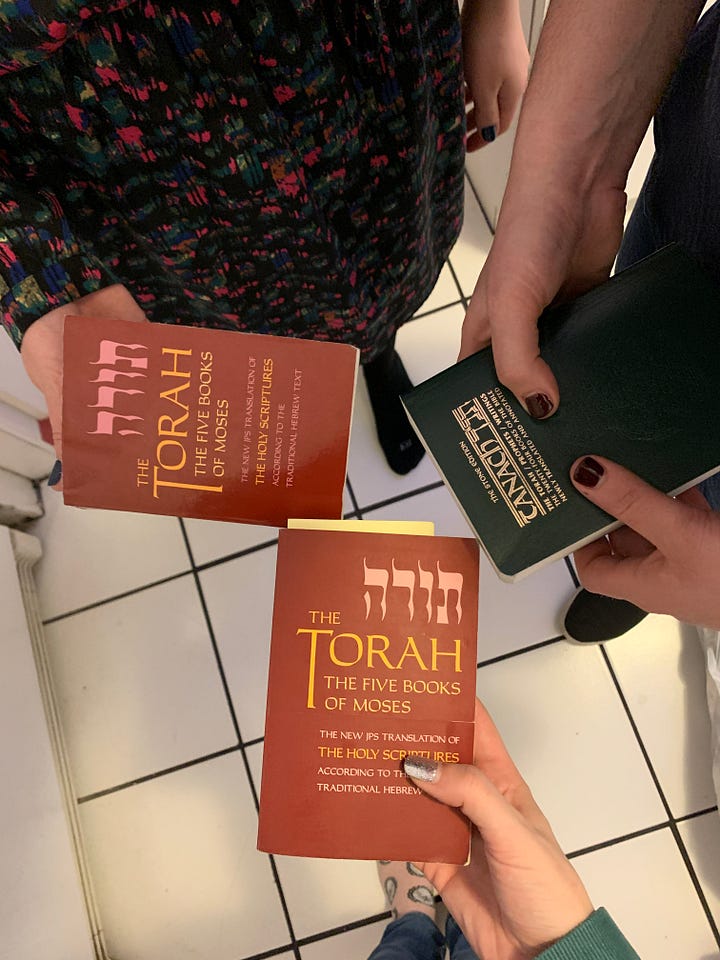
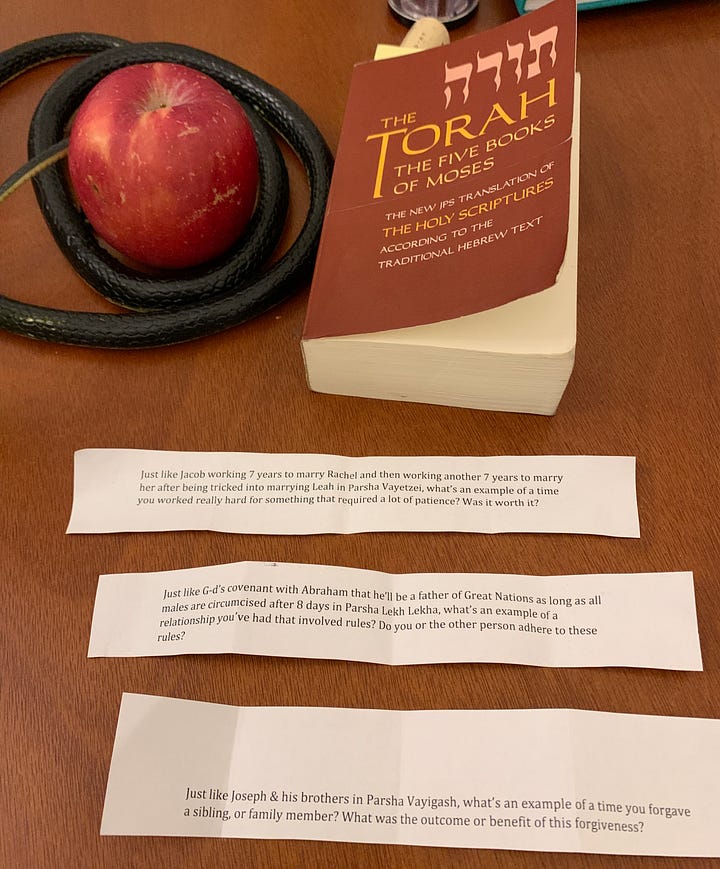
Note the snake around the apple. The detail we had!


It was only years later that I realized we were reading our most sacred text all wrong. We discussed it like a typical book club, gossiping about the characters and reacting to every plot twist, like, “Can you believe Moses couldn’t go into the Promised Land? I was really rooting for him!” *sips Chardonnay*
Also, in the spirit of honesty, I would often procrastinate and binge-read the night before, rushing through the chapters like they were the latest ACOTAR. Except instead of reading about romance in castles under starlit skies, I was falling asleep over pages and pages of laws.
Look, there’s no “wrong” way to do Judaism, but that’s not how you read Torah.
You take it slow, reading (mostly) a parsha, or chapter, a week. You preferably read it in community, or with a rabbi or teacher, dissecting lines and sometimes even words together. And if you love bonus content, you read Torah commentary by scholars who have interesting and sometimes varying opinions! It can be fun but daunting for someone like me who has never really studied Torah before, aside from my Bat Mitzvah and a few times at MJE.
But I’m proud to say that this was the first year I actually kept up with the weekly parsha!
Okay, okay, I didn’t read the entire parsha from its original source most weeks. So when I say my “year of learning Torah," I wasn’t in seminary hunched over books all day. But I kept up with what happened each week, and learned how to interpret it through classes, d’vrei Torah (words of Torah) at synagogue, Substack summaries, and books on the subject. That’s more than I’ve ever done. I’m finishing this Torah cycle with a bang!
Yes, welcome to the Simchat Torah Drop! The joyous holiday where we dance around with Torahs in the street starts tomorrow evening. In honor of ending the Five Books and returning to Bereshit, the beginning, here are some general takeaways from my year of learning Torah.
I could write a whole other Drop on some of my favorite niche interpretations I’ve learned (one of which I’ve shared here), but I wanted to keep this one more general for those who are also starting out like me! This Drop is for anyone looking for a more accessible way to read Torah.
I know some Drop readers are actual rabbis, or rabbis-to-be, or just so knowledgeable in this stuff they can study it in their sleep. So if you’d like to chime in on any of these points, please feel free in the comments!
Now let’s hit it. Or, rather, touch it then kiss it.
Real? Not real? Who cares!
I’ll never forget the time when, some years ago, I was learning the structure of the Tanakh2 with my Orthodox chevruta. When we arrived at Kings, I said, “Oh, so this is the real part.” She looked at me and said as a matter-of-factly, “All of it’s real.”
I’m not sure why I blurted this out. It’s not like I had ever previously doubted the existence of the Torah’s stories. And even if I had, who am I to insinuate to this woman that Kings has more worth just because there’s archaeological evidence for it? What’s real anyway?
Maybe at the time, I just wanted the Torah to also hold some historical accuracy so I could take it seriously as a source of truth and wisdom.
I mean, a staff turning into a snake? Hundreds of thousands of people walking through a parted sea? Come on!
Then again, my dad (and scholars) said the Hebrew Bible could have been based on actual events. For example, there could have possibly been a major flood that inspired the one that covered the entire earth from the story of Noah. The salty region of Mount Sodom could have inspired the story of Lot’s wife. Heck, whenever I visit the Dead Sea, I feel like a salt pillar!
Lest we forget the Merneptah Stele, an Egyptian inscription from ~1200 BCE that describes Pharaoh Merneptah’s military victories and mentions Israel as a people living in Canaan. It’s the first known mention of Israel outside the Bible. So at least there’s evidence the Israelites were there 3,200 years ago, thanks to the rigorous note taking of our enemies!
So, was the Hebrew Bible historically real? I’m not writing to investigate this. Nor do I judge those who believe it was all real. I’m writing about a perspective shift I had this year that helped me view Torah differently. Someone described the Torah to me as being Jewish mythology, which made me think about how and why we study it. In other cultures, mythology can be used as a tool for story telling, memory preserving, and lesson bestowing. It only makes sense that Judaism does the same thing.
This idea of Torah-as-Jewish-mythology helped me realize I don’t need something to have historically happened for it to have sacred meaning. Instead of believing G-d created the world, I explored questions like, “What does the order in which G-d created the world in Genesis tell us about the significance of man’s relationship with animals and nature? With creation? With resting?”
Maybe the fact that the Torah offers us so many questions like these, and in turn, so much wisdom and guidance, is what makes it “real” to Jews.
You don’t have to agree with or even like everything in the Torah
As we all know, one of the reasons why Judaism is great is because it welcomes disagreement. Not only that, but the idea of wrestling with G-d. It’s where the name Israel comes from (Genesis 32:28 to be exact).
One book that was my anchor for learning about Torah this year was It Takes Two to Torah by Abigail Pogrebin and Dov Linzer. An Orthodox Rabbi3 and Reform journalist discuss the Five Books, learning from each other and oftentimes not agreeing with each other. I previously mentioned the book in this Drop when I joined a Torah class that used it to study parsha, and highly recommend it to anyone dipping their toes into Torah.
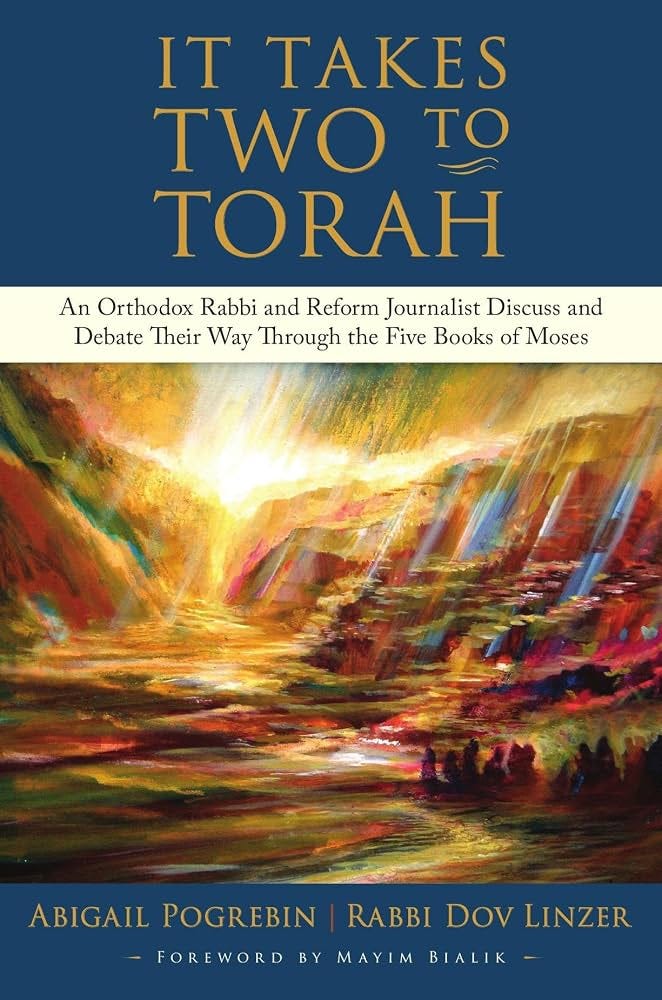
The first time I ever picked up this book, I randomly opened to their dialogue on Parashat Bo. Abby and Dov were discussing how the tenth plague - the slaying of the firstborn - doesn’t sit right with them morally. It wasn’t justifiable to punish innocent babies to free the Israelites.
The pair debated whether or not it’s better to struggle with a good question (“How is it fair that the innocent were killed in this plague?”) than to accept a bad answer. Or is dipping your pinky in wine and symbolically dropping ten drops of wine on your plate on Passover enough to remember the loss of life?
While they couldn’t agree, the book reassured me that even an Orthodox rabbi can’t get behind everything G-d does in the Torah. Baruch Hashem!
Law for the times, wisdom for the ages
It’s easy to read Torah and immediately dismiss it as outdated and harsh. Prohibitions against sexual relations between men, stoning… there’s a lot in there I won’t defend.
But this year, I learned that some of these laws actually hold deeper meaning.
Take, for example, the law for when an Israelite soldier wants to capture a beautiful woman during wartime. We recently read in Parashat Ki Tetze that he must first keep her in his home for 30 days while she is left to mourn her mother and father. She must be made physically undesirable (ex. shaved head, cut nails) so that he does not want her. After the 30 days pass, the soldier may marry her. If he ultimately decides he no longer desires her, he must set her free.
How barbaric! Shouldn’t the law just prohibit soldiers from taking female captive in the first place?
As I learned in Rabbi Alan Lew’s book, This is Real and You Are Completely Unprepared, the Torah acknowledges the wartime tradition of taking captives and treating them as property. Impulse is a part of human nature, after all. But the 30-day mandated period creates a ritual designed to let impulse pass by creating distance from rage, lust, and possession.
It’s like saying, “I bought this expensive dress, but I’m going to wait 30 days and see if I still want it, and if not, I’ll return it.” To take the analogy further, you purposefully make the dress ugly so you desire it less. You cut off the sleeves and remove the bejeweled collar. Good luck returning the dress now! Okay, that might not have been the perfect analogy…
With this law, the Torah does something unprecedented. While still acknowledging the common practices of the ancient world, it calls for the Israelites to do something countercultural: to recognize the human dignity of a captive by seeing her as an individual, rather than as an anonymous prisoner of war.
As you can see, in the past year I’ve developed a deeper relationship with Torah. There’s so much more to it than thinking it’s either perfect or completely outdated.
I’ve learned about humility and patience through Moses, leadership from Jethro, and the importance of opting into community through the construction of the tabernacle, just to name a few other examples.
From creation → revelation → redemption, this is our great story. And just like Abraham, who listened to “Lech lecha” and left everything he knew, and just like the Israelites, who left Egypt in pursuit of freedom, I choose to opt into that story, too. I want to see myself not just as someone who inherits this story, who had to learn a part of it at the age of 12 and never thought about it again, but as someone who chooses to be part of it. And through learning more Torah, and celebrating Torah in the streets of Brooklyn on a cool Autumn night, I feel like I am making that choice. And what joyous choice it is.
Bonus Torah recs!


I received Katia Bolotin’s Making It Relevant: Timeless Torah Wisdom for this year’s Torah cycle, and I can’t wait to deepen my parsha learning with it. Get the book so we can learn together! Virtual chevruta?!
I also received delicious Shabbat discussion cards from M2: The Institute for Experiental Jewish Learning to enhance my Friday night meals!
Shabbat Shalom! Lech lecha,

💦 If you like Torah, check out these Drops:
Bo Means Go

My first-ever d'var Torah which I gave at MJE in 2022, a poem about Parashat Bo. Plus, a recipe for triple chocolate almond mandelbrot!
The Significance of Re'eh-visiting Old Lessons

A d'var on Parashat Re'eh, when Moses recounts lessons from earlier to the Israelites as part of his final address before they enter the Promised Land. Why am I getting déjà vu? Why is Moses being so repetitive? Maybe it takes repetition for some lessons to stick.
Meet Brother Shlomo, a Jewish Freemason

An interview with Brother Shlomo, an Orthodox Freemason, and his d'var Torah for Parashat Tetzaveh, comparing the dress of the Kohanim to the formal Freemason dress code.
Coined by German historian Jan Assmann. Here’s a piece relating the term to Jewish history and memory.
TaNaKh is the entire Jewish Bible, and is an acronym for the Hebrew words of what it contains: the Torah (the Five Books, which is what this post is about), Nevi’im (Prophets), and Ketuvim (Writings).
Side note: Dov Linzer was at my friend’s wedding this year and I totally fangirled over him. Same for Abigail at a different event.
This is so, so good
Kol hakavod that you stuck with it! I think the beauty of the Torah is that there is always more to learn.
I don't know if mythology is necessarily correct but I think a morality book is very much appropriate. More evidence to this theory is the fact that the torah sometimes discusses events out of order, and the lyrical prose that is used to tell us about things.
I'm going to finish with my 2 cents on the 10th plague. Without even looking at commentary, the Egyptians have committed a great evil in enslaving a nation and murdering their sons when that didn't work fast enough. They had the entire time from Moses's birth to repent and they didn't. They chose continuing slavery over and over. A normal person would have had remorse after the first plague. I mean compare it to the king who kidnapped Sarah (also Egyptian). That king repented immediately and even gave Avraham gifts.
The general if slave holder Egyptians was so depraved with "capitalist greed" that they couldn't care less. They were given chances over and over.
You might say, well the Egyptians argued with Pharaoh that he should let the Jews go. Sure, but in the night of the 10th plague they also had the choice to abandon idol worship and paint their doorways in blood like the Jews did. In fact, we know that some non Hebrews left Egypt with the Hebrews. Those who were affected by the 10th plague cared more about their animals than about enslaving, torturing and murdering human beings.
So the punishment was just but at the same time, it is Gd who gives this punishment. And when he drowns the Egyptians that still haven't learned after all this, he tells the angels they shouldn't celebrate as those Egyptians are his children too.
And as you said, Ashkenazim remove drops of wine for every plague. Our Sephardic tradition is to pour out sips for every plague. We're not happy about the plague but at the same time, I think it's important to remember that the Egyptians had many choices.