

Hebrew Word of the Week:
Say, what’s Outlander in Hebrew, anyway? It’s nokhria (נוכרייה), which translates to "female Stranger" or "foreigner." Which is what Claire becomes when she accidentally time travels to 1743 Scotland!
Last week’s Drop explored the Jewish themes of the hit romantic TV and book series, Outlander, a very non-Jewish franchise. We talked rebellion, preserving identity, and hunky Scottish men.
This week’s exploration has more of a direct Jewish connection, because we’re discussing the Jewish characters in Outlander! And not just the Jewish characters, but how they’re portrayed.
Even if you don’t care about Outlander, we’ll discuss very real 18th-century Jewish history. Plus, it’s interesting to see how Jewish characters are portrayed in literature, like Fagin in Oliver Twist, or Shylock in The Merchant of Venice.
The good news is that Outlander’s Jewish personalities are depicted as less villainous and more complex. And since the author, Diana Gabaldon, uses accurate research to recreate 18th-century Scotland, she considers not just their traits, but also the historical context in which these characters are perceived.
For a refresher on the basic plot of the show, read last week’s Drop!
This is personally one of my favorite Drops! So get comfy, pour yourself a dram of Scotch, and say sláinte! 🥃
Outlander’s Jewish characters
For those of you who watched the show, you’re probably thinking, “I don’t remember any Jewish characters.”
You’re right! There are five minor Jewish characters in the books only, four of them alive.
A Rothschild realization
Let’s start with Book 3. The year is 1766. Without giving too much away, Claire and Jamie obtain a mysterious chest of ancient coins, and are trying to figure out where it came from.
To find answers, they seek out a young coin dealer from Frankfort (the 18th-century spelling) who is an expert in ancient coins. The young man introduces himself as Mayer, and is described as such, in Claire’s voice:
“Since virtually no one in Le Havre other than a few seamen wore a beard, it hardly needed the small shiny black skullcap on the newcomer’s head to tell me he was a Jew.”
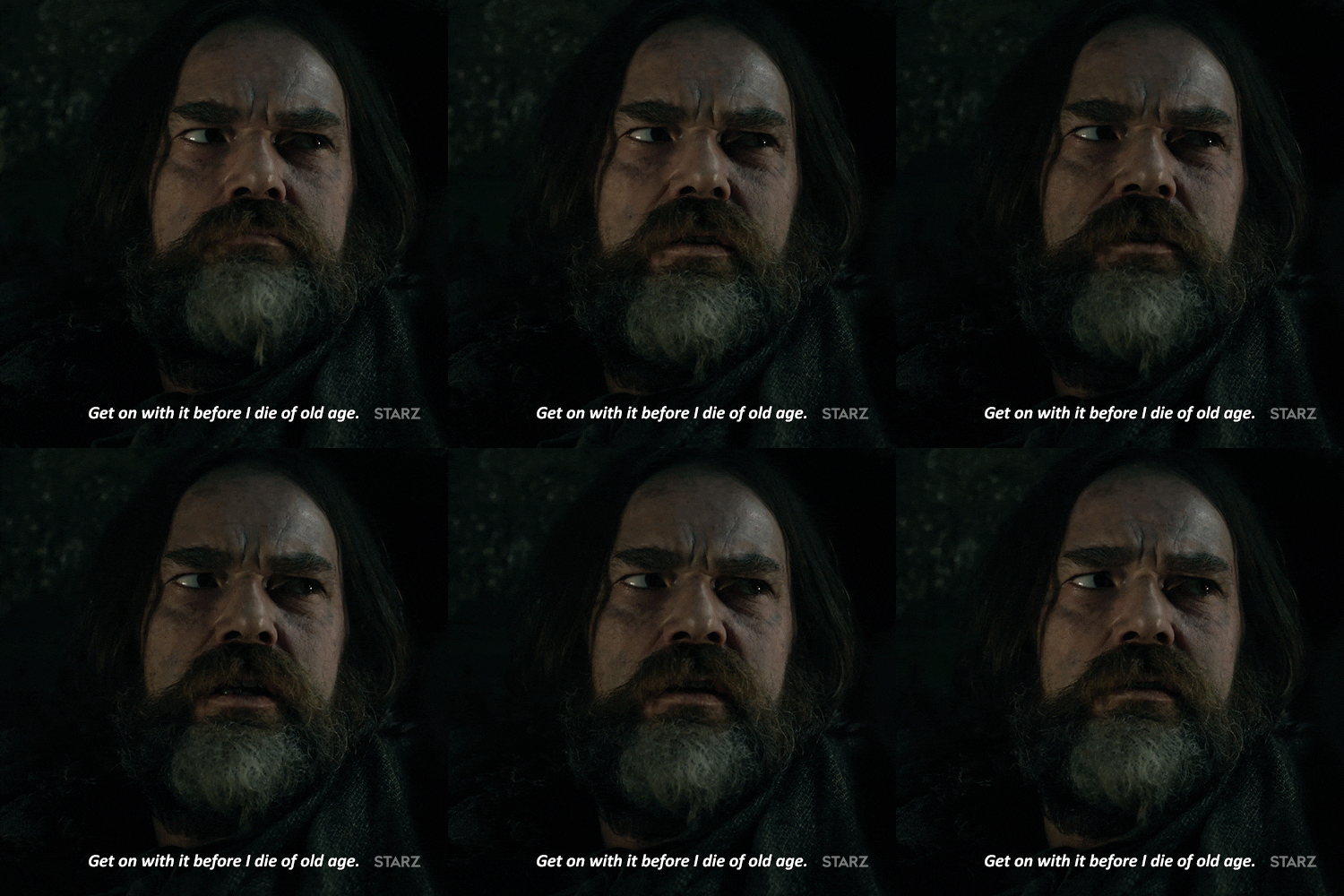
Mayer is also described as appearing dusty and reserved, with an intensely curious expression. While Jamie compares the coins he has seen to the coins in Mayer’s collection, the Jewish merchant takes out his ledger of dealings, which are written in a “Hebraic writing, inked small and precise.”
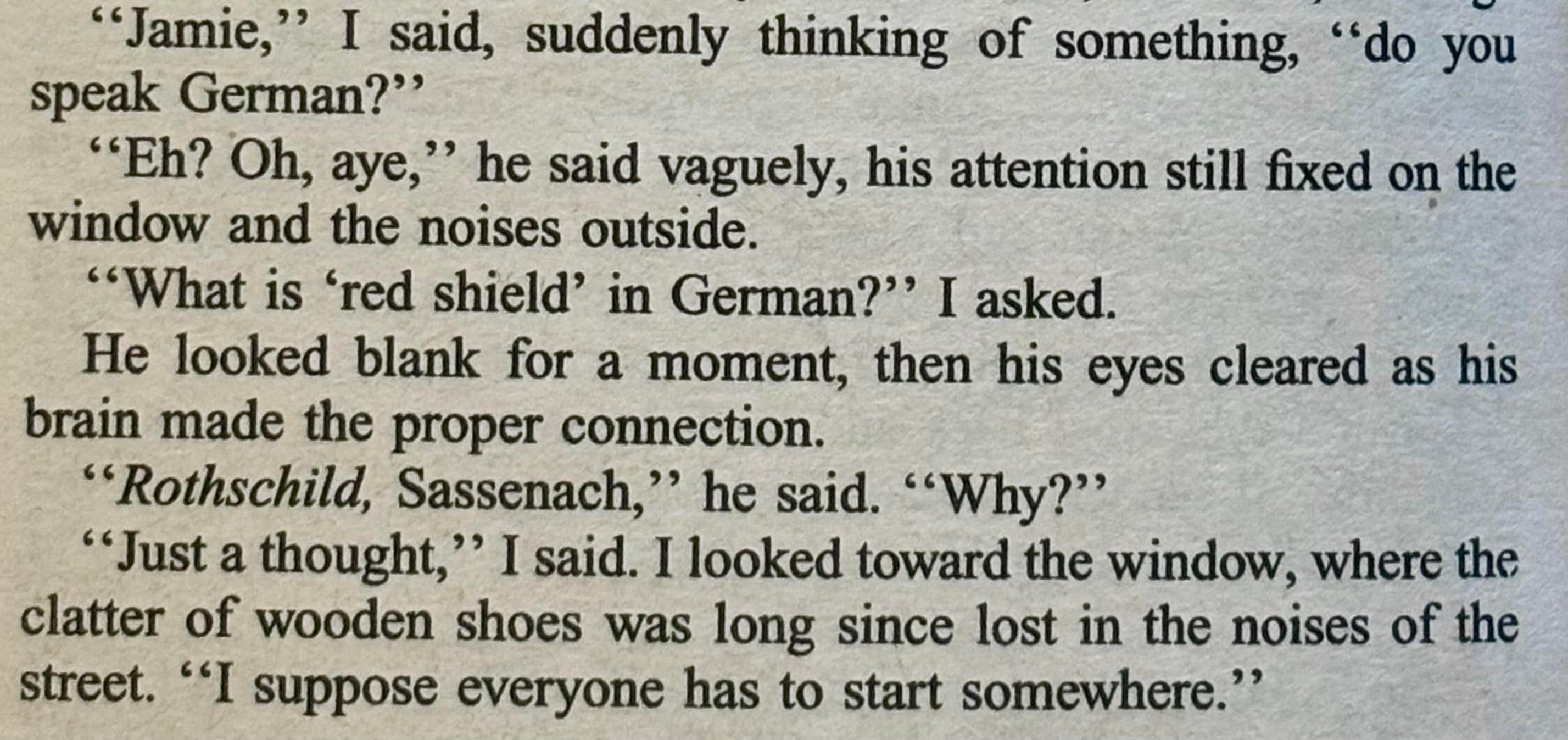
After their dealings, Claire asks the man if Mayer is really his only name. He explains that the Jews of Frankfort are not allowed to use family names1. For the sake of convenience, their neighbors call their family after an old red shield that was painted on their house years ago.
Jamie then refers to him as “Mayer Red-Shield.” That’s when Claire realizes who Mayer is (remember, she’s a time traveler from the 1940s) - Mayer Amschel Rothschild - and the banking legacy his family will one day represent2. You can read it for yourself:
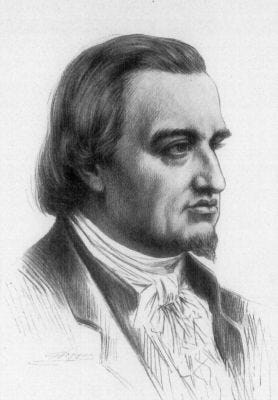
The real Mayer Rothschild, founder of the prominent Jewish banking family, established his business in 17693.
Author Diana Gabaldon uses incredibly accurate research to get every detail right in her 1,000+ page books. She’s even written books about her writing and research process, explained in fat books called The Outlandish Companions, of which there are two!
Throughout the series, there are a few famous historical figures Claire meets on her adventures. Meeting them, like Mayer Amschel Rothschild, is a literary delight for us modern readers.
Lawrence Stern, the helpful naturalist
Not long after meeting Mayer, a lot of exciting things happen that involve a ship and Claire and Jamie getting separated. Without major spoilers, Claire ends up on the island of Hispaniola (modern-day Haiti)4.
There, she meets a Jewish German naturalist named Lawrence Stern, whose appearance is described as weathered and burly, with “black hair that curled back from his brow, thick and ungrizzled.”
Lawrence offers Claire water, and brings her to his friend’s house (who happens to be a priest) to take shelter. There, the priest’s mother-in-law refers to Lawrence as a “Christ-killer.”
But the Jewish representation here proves to be positive. Over sangria, Lawrence tells Claire about the fauna and topography of the land, which foreshadows the book’s climax. He continues to help Claire, and even says “Oy!” at one point.
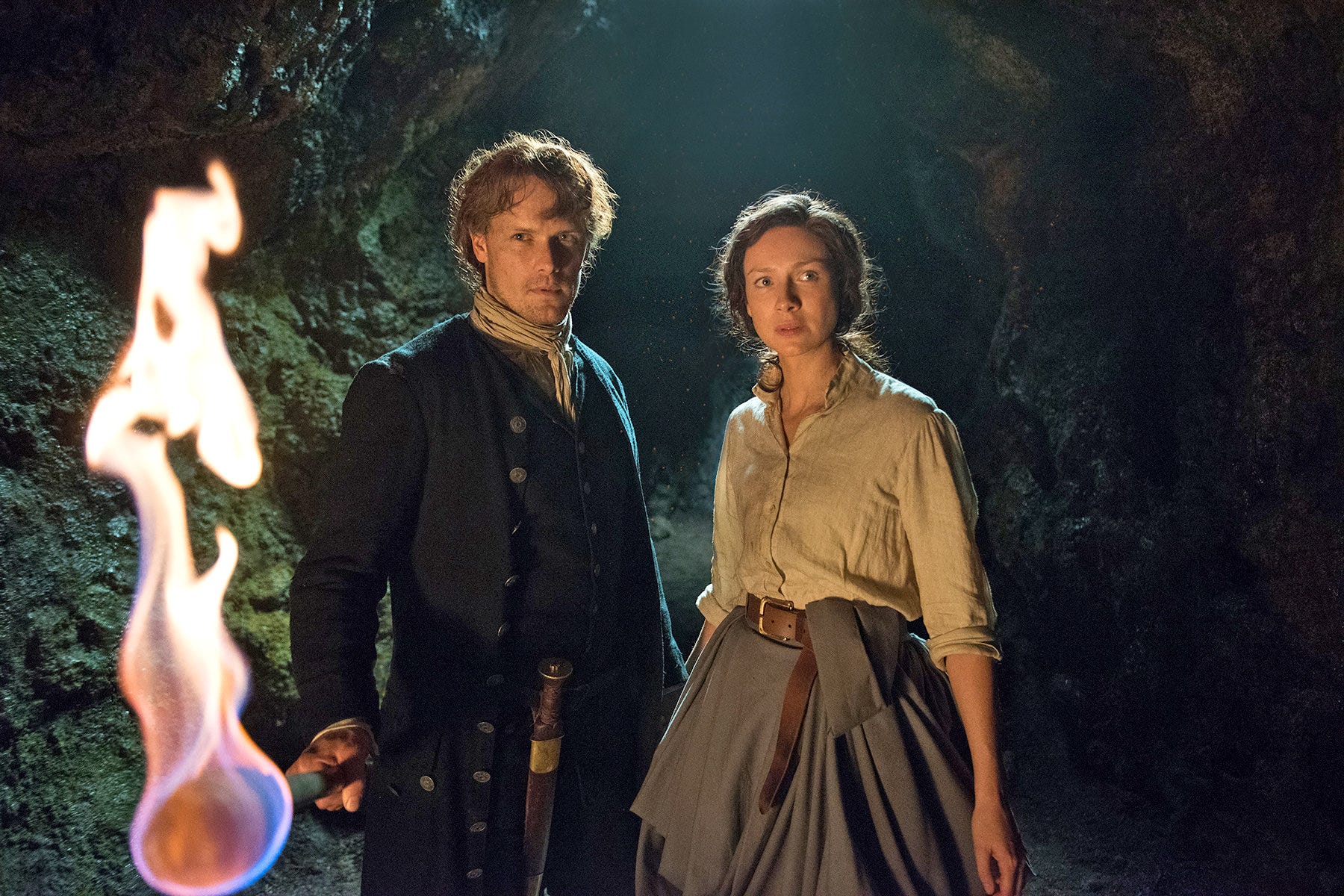
Those who have seen the show will recognize this as the Father Fogden scene. Only… there’s no Jewish character in this scene at all. Just a disgraced priest, a disgruntled mother-in-law, and a coconut that doesn’t talk back.
I don’t think the TV adaptation omitted Mayer and Lawrence because they’re Jewish. The books are simply too detailed to include all the minor characters on screen. Having said that, it would have been meaningful to see Lawrence included, to depict a learned Jewish man helping Claire, while also highlighting the antisemitism he faces.
The corpse with the circumcision
Here’s where things get mysterious. And educational!
In Book 9, Go Tell the Bees That I Am Gone, Claire and Jamie become involved in the investigation of an unknown dead man. When a local constable asks Jamie if he thinks the man was a Jew, Jamie says:
“How would I ken that? And why would ye think so? Oh—did ye look at his prick?”
Horrified, the constable asks why he would do such a thing. Jamie replies, “D’ye not ken Jews are circumcised, then?” as though the constable should know (Jamie’s character is not only known for his good looks, but is also educated and worldly). Jamie then explains the practice.
The constable replies, “Jesus Christ! What the devil do they do that for?” Jamie says with a shrug, “God told them to.”
It turns out the constable thinks the dead man was Jewish because his body was found with a paper inscribed in Hebrew.
But it was an interesting choice on Diana’s part to include this minor detail and educational moment.
This led me to search the non-Jewish perception of circumcisions in 18th-century. While most non-Jews knew of circumcision thanks to the Bible, they didn’t have much knowledge of the actual procedure, since the ritual was performed by Jews in insular communities.
There were also widespread misconceptions about the practice and of the sexuality of Jewish men in general due to antisemitism and societal fear of venereal disease.
In 1753 London, the Jewish Naturalization Act, known as the Jew Bill, passed to grant citizenship to foreign-born Jews. But many opposed the act due to a widespread fear of “universal circumcision.”
In classic antisemitic fashion, it was believed that Jewish men were both sexually deviant and impotent, and that their circumcisions protected them from venereal disease while also causing venereal disease.5
This false belief was sometimes depicted in satire that American colonists read, so the Penis Panic (I just came up with that) spread to the colonies. Oy!
Circumcision would not become familiar to Americans as a medical procedure until 1870, when Dr. Lewis Sayre, a prominent New York orthopedist, popularized it.6
All this is to say: some 18th-century Christians were weirded out by brit milah, and it was accurate to portray the constable as such.
I get it. I imagine it’s how I feel when I think about the opposite: uncut gems, so to speak.
Rebekah bat-Leah Hauberger, bandit informant
There are a ton of prequel novellas (the Outlander universe is huge and thankfully never ending).
In one titled Virgins, a story of young Jamie as a soldier in France, he meets Rebekah bat-Leah Hauberger, a young Jewish woman who’s involved with Jewish bandits, informing them on which wagons to rob.
Rebekah falls in love with a French nobleman who promises to convert to Judaism. However, her grandfather, a physician named Dr. Hasdi, doubts the man’s promise to convert, since he would lose his title and property if he did so. Dr. Hasdi hires Jamie to protect his granddaughter and a valuable Torah scroll in her care.
Yes, you read that right: our highland warrior Jamie who can recognize Hebrew and knows about circumcision ALSO protects a Torah scroll. Is he a secret Jew like AI Jamie says he is?!
Incoming spoiler: Later, it’s revealed that Rebekah’s only involved with the bandits so that she could make up for the wealth that her lover would lose when he converts to Judaism.
Jamie convinces her to return the Torah to her grandfather, forcing her to confront her love for the goy while confronting her faith.
Bet you didn’t see THAT one coming!

Historical context: I couldn’t find much on 18th-century Jewish crime in France. However, I found a translated excerpt from a Jewish journal7, saying that French Jewish crime was low compared to non-Jewish crime, and involved smuggling and robbery. This doesn’t surprise me since Jewish piracy was a thing in the 17th century. The crime in France was likely due to being marginalized and the police being suspicious of Jews.
Diana Gabaldon’s Jewish connection
Why would the author depict these Jewish characters, anyway? What’s the point?
A Roman Catholic herself, Diana has shared on social media many times (always acknowledging the Jewish holidays!) that she believes her father’s ancestor was likely a Sephardic Jew who arrived to the New World through Mexico City.
Her curiosity and passion for research and religion leads her to weave these fascinating plotlines and minor characters into the Outlander universe, for which we Jewish fans are grateful!
Shabbat Shalom! Stay curious,

💦 If you like circumcision, check out these Drops:

What does Maimonides have to say about erectile dysfunction?

From Iceland's penis museum to posthumous sperm retrieval in Israel, this Drop is a roller coaster ride of silly and serious. 🍆
Most European Jews didn’t use actual surnames until the late 18th & 19th centuries, and Ashkenazi Jews were the last to do so. Until then, they used what’s called patronymics (like “Isaac, son of Abraham”), where they lived, or their occupation. https://jewishjournal.com/culture/126045/
Along with the antisemitic conspiracy theories that come with the name!
As you can see on the official Rothschild site, he begins their timeline: https://www.rothschildandco.com/en/about-us/our-story/
Hispaniola actually comprised the French colony of Saint-Domingue on the west (today’s Haiti), and the Spanish colony of Santo Domingo on the east (today’s Dominican Republic). Outlander is more than romance - it teaches you so much!
I didn’t think I’d be writing this much about circumcision this week! https://pmc.ncbi.nlm.nih.gov/articles/PMC9985765/
Great Drop, thanks for the deep dive into history, was very interesting to read (but I doubt I will ever watch the show, oh well!)
BTW your post reminded me of two books I've wanted to read for a while: Shylock Is My Name, by Howard Jacobson, and Fagin the Thief, by Allison Epstein. Retellings of Shakespeare's Merchant of Venice and Dickens's Oliver Twist from the perspectives of Shylock and Fagin. Will try to kick them higher up the pile, might be of interest to you as well if you haven't read them yet.
Also reminded me of an interesting book I read many years ago, called Why Aren't Jewish Women Circumcised, by Professor Shaye Cohen. Despite the provocative title, it's a fairly academic and dense (he's incredibly smart) cultural history/investigation of the significance of circumcision in Jewish culture and religion, in contrast to the significance of baptism in Christian culture, to which it has has been inaccurately compared.
Love that you found the Jewish angle to The Outlander. I loved the first few seasons & then stopped when they were living in the woods of American South. I am obsessed with their theme song though!