

Hebrew Word of the Week:
This week’s word is grapefruit, or eshkolit (אשכולית), because I’m having a hard time remembering it… much like the word for “to forget”!
This was a heavy week, as we first observed Yom HaZikaron, Israel’s Memorial Day, before transitioning to the celebratory Yom Ha’atzmaut, Israel’s independence.
Israelis began marking Yom HaZikaron in 1951 to honor their fallen soldiers. For the first two year’s of Israel’s independence, the commemoration was held on the same day as Independence Day, but a decision was made to designate a national day of mourning. The day was enacted into law in 1963. In 1980, the day expanded to include pre-state fallen soldiers and security force members. More Jews in the diaspora began observing the holiday as well.
In the early 2000s during the Second Intifada, the holiday again widened its scope to include victims of terror, changing its name to Yom HaZikaron l’Chalalei Ma’arachot Yisrael u’LeNifga’ei Pe’ulot HaEiva (Remembrance Day for the Fallen Soldiers of the Wars of Israel and Victims of Actions of Terrorism).
Then in 2023, the scope expanded again to include non-Israeli Jewish victims of antisemitic terror attacks outside of Israel, per Israel’s Ministry of Diaspora Affairs and Combating Antisemitism. Don’t worry - this addition didn’t get tacked onto the holiday’s name this time. This decision to include victims of terror and antisemitism on a day memorializing soldiers reminds us that victims of hate are also soldiers; they are victims of the same fight. Plus, how many more sad days can we tack onto the Jewish calendar?


Something similar happened with Yom HaShoah, Israel’s Holocaust Remembrance Day, which we observed last week. In 1959, the Knesset, Israel’s Parliament, changed its name to Yom HaZikaron laShoah ve-laG'vurah, or Holocaust and Heroism Remembrance Day to institute an annual "commemoration of the disaster which the Nazis and their collaborators brought upon the Jewish people and the acts of heroism and revolt performed."
This nominal addition dispels a misconception of the Holocaust, that every Jew went like lambs to the slaughter toward their death. It honors the Jewish heroes of the Holocaust: those who hid in the freezing forest, who blew up Nazi train cars, who protected sacred Jewish texts, who successfully and unsuccessfully rescued Jews.
These name changes are a powerful reminder that our history contains chapters of both heroism and tragedy, of suffering and courage. They teach us that the Jewish story continues to have hardship, but it contains acts of heroism and resilience as well.
Which brings me to one of the best Jewish books I’ve read this year so far! Out of the Sky by journalist and author Matti Friedman explores real heroism during the Holocaust through the lives of four parachutists. Their mission was to return to Nazi-occupied Europe after having already escaped to Palestine to rescue as many Jews and allies as they could, and kill Nazis along the way.
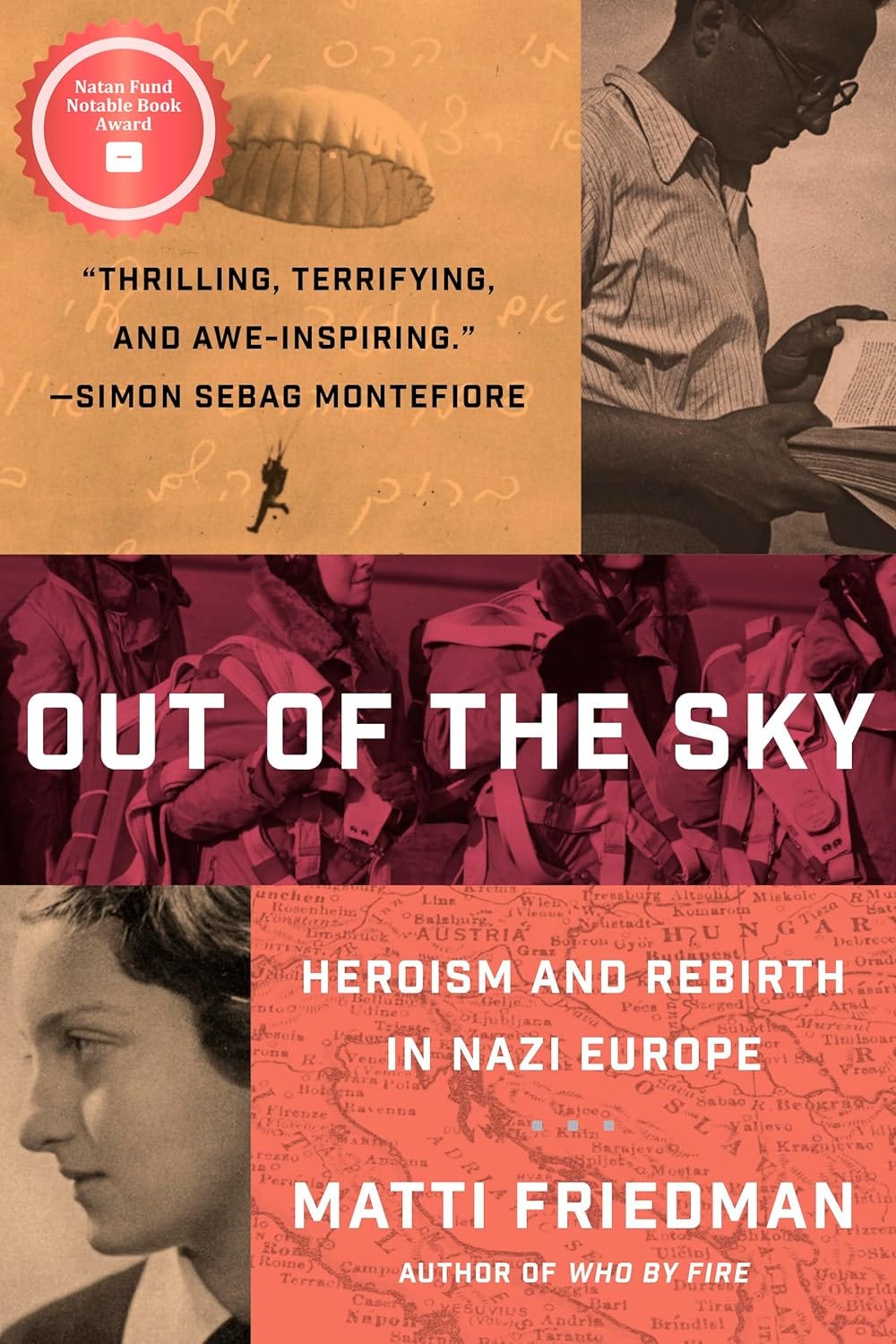
I loved this book because it asks the question: What makes a hero? The parachutists’ mission failed. Only one returned to Palestine alive. Yet, they each became legends in their own way for their courageous attempt to restore justice. They posthumously had streets, schools, and ships carrying immigrants to Palestine named after them. The most famous parachutist, Hannah Senesh, wrote the poem “Eli, Eli” which became a song every Israeli child grows up learning. Just last week, I heard it sung by a children’s choir at a Yom HaShoah event.
Through letters, firsthand accounts, and private reports, we get a glimpse into the hearts and minds of Hannah, Enzo Sereni, Haviva Reik, and Haim Hermesh. My favorite character was Slovakian-born Haviva, the brains of the operation once they were on the ground, but dismissed for being a young woman. She also slept around, sometimes with other women’s husbands on her kibbutz. I have a soft spot for imperfect heroes, what can I say? It’s why I love the Torah so much!
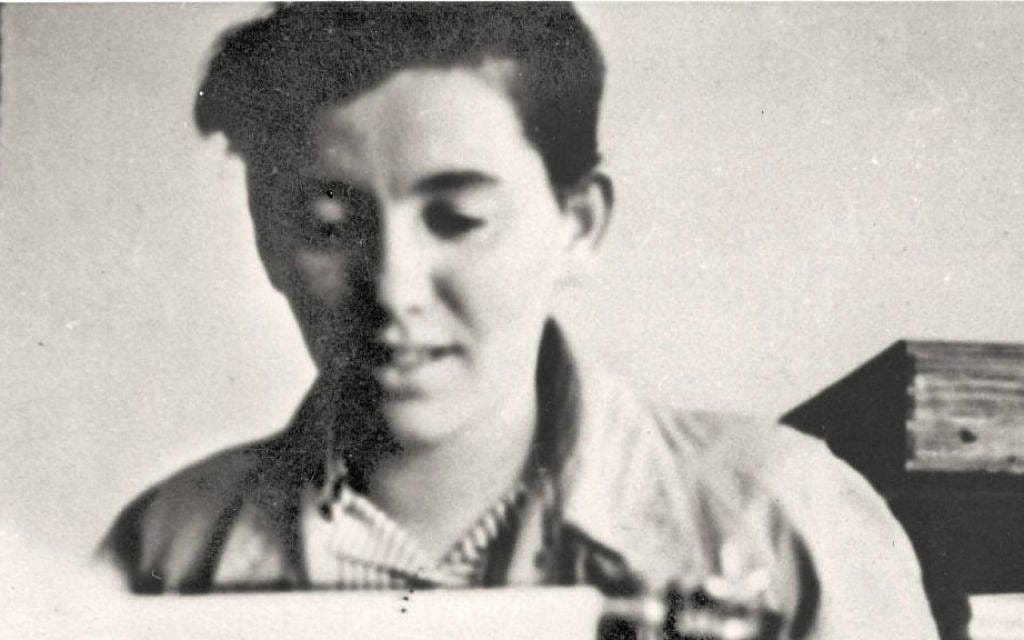
None of the story’s main characters were perfect. Even some resistance fighters thought Hannah Senesh too brash, a young woman too headstrong for her own good.
But they all had one thing in common: a Zionist yearning to help their fellow brethren and bring them to safety, no matter the cost. And they didn’t see this as a heroic act, but what was needed to be done. In fact, they didn’t want to be remembered as heroes. Oops.
Out of the Sky is proof that storytelling and memory matter almost as much as wartime success, even more so. These four parachutists may not have literally saved Jewish lives, but they gave living Jews strength. They became symbols of what a new nation needed to carry on.
As I mentioned earlier, Yom HaZikaron fades into Yom Ha’atzmaut in a single sunset. In 24 hours, we go from mourning the dead to celebrating independence, however that feels for you this year.
One lingering question I had after I finished the book was if these parachutists were so devoted to Zionism, wouldn’t it have been a more redemptive ending to the war to just stay in Palestine and live as free Jews? Perhaps survivor’s guilt led them to pursue their lofty goal, the fact that they fled while their families remained stuck in Europe. But then they never would have become the notable figures they are today, and we wouldn’t have this thought-provoking book.
Today, we thankfully have the choice to carry out their dream of living freely as Jews. We can be activists, like Enzo in his youth movement. We can tell our story, like Haim did when he returned from the war. We can study Hebrew like Hannah, or sleep with other women’s husbands like Haviva. Just kidding about that last part. She did so much more than that!
As Matti Friedman writes: the Zionist response is action. If Yom HaShoah reminds us what happens when there’s no Jewish state, and Yom HaZikaron reminds us that having a Jewish state comes with a price, Yom Ha’atzmaut reminds us of the power of having a Jewish state and of the responsibility that comes with it to take action. What that action looks like, I leave that for you to decide.
🎁 GIVEAWAY
Thanks for making it this far! I’m giving away a signed copy of Out of the Sky to one lucky winner!
To enter, all you have to do is like and share this post or any past post somewhere, either by restacking on Substack, sharing on social media, or in that WhatsApp group chat you usually mute (send screenshot pls!). The eligible winner must live in the U.S. and must subscribe to The Shabbat Drop. I’ll post the winner next week.
✨ Jewish Joy of the Week
I went on a friend’s Polish food tour in Greenpoint. The pastries were delicious and the company was great. My favorite part, though, was when I found out my friend’s brother-in-law is someone I used to work with, one of the three Melbourne Jews I know. Small Jewish world!
Shabbat Shalom,

💦 If you care about Jewish resistance, check out this Drop:
"My Thoughts Are Free"

Bravely collected by members of the Oneg Shabbat Society, a secret group of Jews in the Warsaw Ghetto, the poems were hidden in buried milk cans as part of a larger mission to document ghetto life for the future. And life is exactly what they contain: the poets wrote about everything from bagels to heartbreak, from anger to faith.
It is worth noting that Israel, a newly formed nation, was hardly fullly receptive to Holocaust survivors who had relocated to Israel: https://www.perplexity.ai/search/bec235ff-ccdd-493f-9b7a-0c03675c6a47
If there is the notion that Jews went to their deaths like sheep, then we have many notables who embrached that notion, including Bettleheim, Hilberg, and Hannah Arendt. https://share.google/aimode/s707Khf1idmeyPipD