

Hebrew Word of the Week:
Yesh li chalooom, shir lashir. 🎵 Anyone an ABBA fan?! This week’s word is chalom (חלום), which means dream. As in, “I have a dream, a song to sing.”
When you think of Jewish immigrants arriving to America, what do you see?
If you pictured a crowded ship pulling into New York Harbor, the towering Statue of Liberty evoking The Brutalist, and families clutching their luggage at Ellis Island, you’re right. Between 1880 and 1914, over two million Jews from Eastern Europe made that exact journey. That’s the story we know, and one that many of us can trace through our own family histories.
But after I wrote my Jewish Unpacked piece on Jews of the Wild West and talked to people about this topic, I learned that most Jews aren’t familiar with the lesser-known American immigration story of Galveston, Texas.
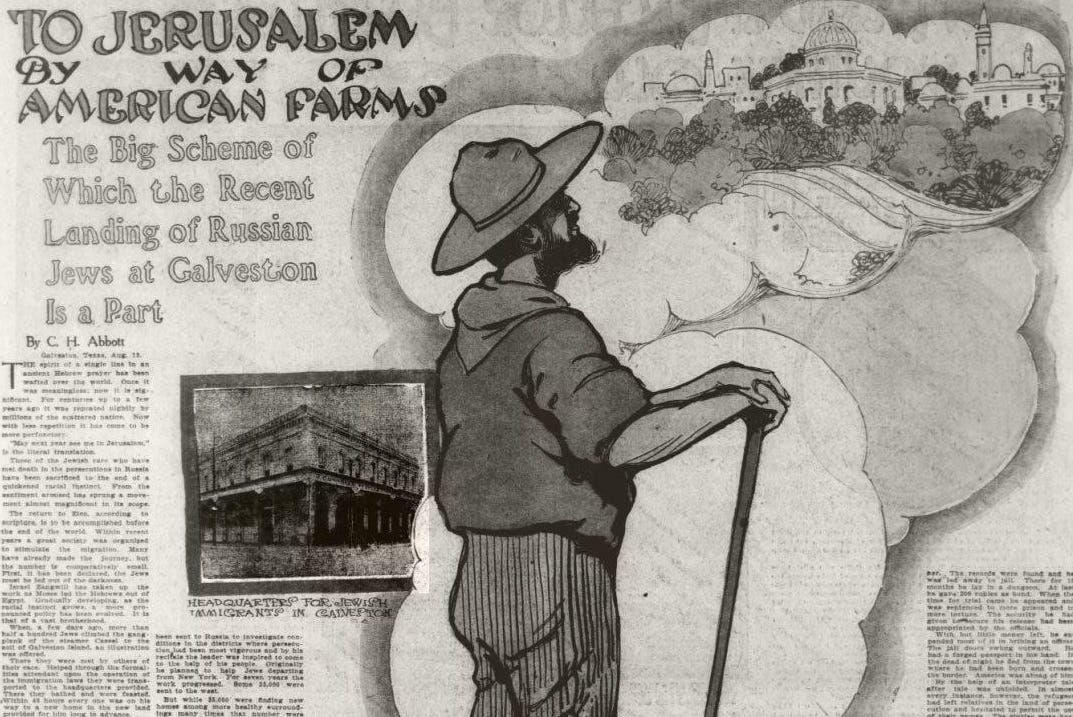
That’s right! About 10,000 Jewish immigrants came through a different port of entry a liiitle more west. In honor of Jewish American Heritage Month, here’s a Drop I’ve been wanting to write about for quite some time, just ahead of Shavuot. Saddle up!
Why Galveston?
As Jewish immigrants poured into Manhattan’s Lower East Side, German-Jewish banker Jacob Schiff was nervous about the overcrowding of Jewish communities in northeastern cities. He felt they would fuel anger and lead to federal immigration restrictions.
So in 1907, he committed $500,000 of his own money (about $13 million today) to set up the Jewish Immigrants’ Information Bureau (JIIB). The goal was to redirect immigrants away from the East Coast and distribute them across the rest of the country, where they would hopefully find work as merchants or cattle ranchers (jobs they held in Europe before emigrating), and blend into communities rather than cluster in urban ghettos.
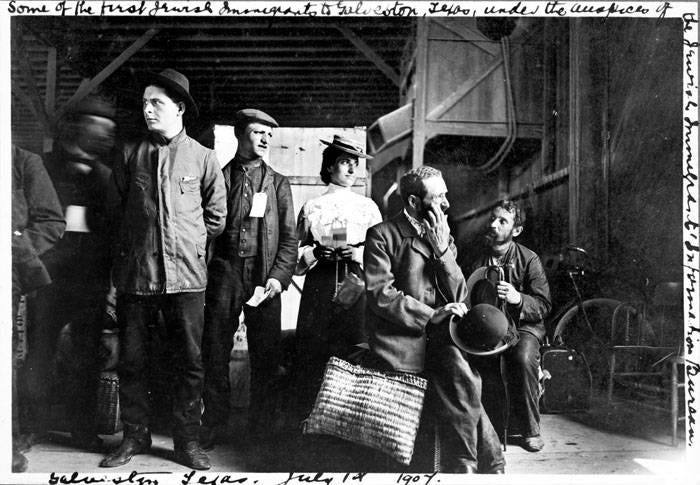
To do so, they needed a port. They evaluated three options: Charleston, New Orleans, and Galveston.
Charleston was out immediately; local officials made it clear they only wanted Anglo-Saxon immigrants. New Orleans had recurring yellow fever outbreaks and was too densely populated. Galveston had direct shipping routes from Bremen, Germany (the main departure point for Eastern European Jews), and rail lines heading straight into the Midwest! Galveston it was.
The Rabbi of the Ellis Island of the West
At the heart of the operation was a man named Rabbi Henry Cohen of Galveston’s Congregation B’nai Israel.
Rabbi Cohen personally met almost every arriving ship. He rode his bicycle to the docks, greeted immigrants in Yiddish, assessed their skills, and coordinated their placement with the JIIB. He had been serving Galveston’s Jewish community since 1888.
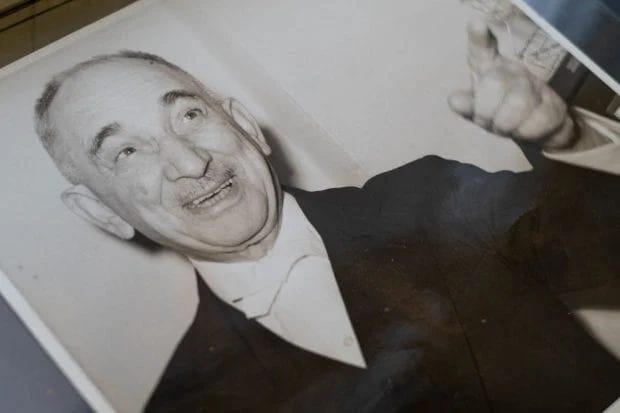
Cohen served B'nai Israel for 64 years, becoming an influential civic reformer in Texas. He lobbied the state legislature to raise the age of consent for girls from 12 to 18, rescued sex workers from local brothels, and helped organize the Central Relief Committee after the 1900 hurricane. In 1930, Stephen Wise included Cohen on a list in the New York Times of the ten most prominent religious leaders in the U.S. And that was the last time that paper said anything nice about Jews. Kidding, kidding.
Everything’s bigger (and more difficult) in Texas
About 92% of arriving immigrants moved west of the Mississippi. Families spread out across Texas, in cities like Tyler, Palestine, Marshall, San Antonio, and into Missouri, Iowa, and Minnesota.
But over time, most of them drifted back east. This was actually something I did not know until researching this topic this week!
88-90% of adult men eventually relocated to Chicago or New York, drawn by things the JIIB hadn’t fully accounted for: community, kosher food, Yiddish newspapers, synagogues, family. Employers in smaller towns often refused to accommodate Shabbat observance.
Still, the families who stayed planted roots that are still visible today. Jewish congregations, businesses, and civic institutions across Texas and the Southwest trace their origins back to those 10,000 people who got off a boat in Galveston instead of New York.
The movement officially ended in 1914 when World War I shut down transatlantic travel entirely.
A personal connection
My colleague’s family immigrated through Galveston! Here’s what Tova told me about it:
“My great-great grandfather, Philip Rich (born Pinchos Ratschkovsky), came to the U.S. from Russia in 1904 when he was 13 years old. He came through Ellis Island, but continued by boat to Galveston. He continued by train to Richmond to stay with his uncle.
Pinchos was so excited to see his family after the long trip, that he left his straw suitcase on the train. As the train pulled out, he started yelling in Yiddish, and the whole crowd yelled so the train backed up and the conductor threw the straw case out to him.
As an adult, he lived in Houston, Texas, and started the Phil Rich Fan Manufacturing Company. The company was managed for decades by his son, Hershel. The iconic mid-century brand operated until it was sold to Sunbeam in 1981. Today, Phil Rich Windmaker fans are highly sought-after collector's items in the vintage and industrial design markets, renowned for their heavy-duty metal construction and massive airflow.”
So there you have it: a look into a lesser-known immigration story that kicked off the era Jewish cowboys. Read my article to learn about that fascinating part of history!
Sources and Further Reading/Watching
How 10,000 Jews immigrated to the U.S. through Galveston — not Ellis Island
Unboxing History: The Galveston Movement & Rabbi Henry Cohen
New Light on the Galveston Movement: Houston Jewish History Archive Acquires Rare Pamphlet
✨ Jewish Joy of the Week
I mean, it doesn’t get more joyous than me posting on Facebook asking if I know anyone whose family immigrated through Galveston and receiving a few replies!
Chag sameach and happy learning,

Some of the Jews that came to Texas were from Alsace in eastern France. Their experience as merchants in general and livestock merchants in particular served them well. I do genealogy tours for their descendants today! If you happen to be passing through Paris, Frankfurt, Basel or Stuttgart, consider a visit to the Judeo-Alsatian Museum of Bouxwiller to learn more about these folks! https://www.museejudeoalsacien.fr/en
this is what is currently going on in Texas: https://www.yahoo.com/news/articles/democrats-vow-vote-every-single-132231214.html?ref=upstract.com&guccounter=1&guce_referrer=aHR0cHM6Ly91cHN0cmFjdC5jb20v&guce_referrer_sig=AQAAALLgyyacoYfPVjqmPsii96elWWwn2TwKPFbNflZcAXCBV-tlB3T7zMeL2LSeeGV6gg8y1OImVt4TsBmbU25NRZMSg6eGRCiEaPf3e7V3iVPON2WPyDzMXJfr-XsELKNzJnHcmElyAELkJbM7_ts90OV7lzfErSDl1U23qGhJ0MzM