

Jewish Word of the Week:
This week we’re learning Yiddish. Someone recently taught me the male counterpart to “shiksa” (a non-Jewish woman), which is sheygetz, meaning a non-Jewish man. Why did this come up? Because when I told them my partner’s last name is Getz, they suggested we name our future son “Shey.” 🤪
I am a big fan of the Oscars! Not so much the pomp and glam of it all, nor the performative display of politics, but for the genuine love and appreciation of film. Okay, and maaaybe to beat my mom in our annual contest for predicting the most winners for each category (I won this year, in case you were wondering).
This is not a Drop about the Jewishness of the 98th ceremony, like which Jewish celebrity wore what, nor about the Jewishness of Marty Supreme (for an article on that, read this!). It’s also not about the nominated short documentary Children No More: Were and Are Gone, which follows anti-war Israelis raising awareness of children killed in Gaza (haven’t seen it but my thoughts: right message, wrong place; surprised it didn’t win; I’m expecting a nominated doc about how the world turned a blind eye to the Bibas boys and all other children murdered on October 7th).
This is also not about how adorable my parents are. I mean, just look at their costumes!

This Drop is about Butterfly, a 15-minute animated short film directed by Florence Miailhe, a French-Jewish animator. The film tells the true story of Alfred Nakache, a Jewish Olympic swimmer who survived Auschwitz.
Not to snub the actual winner that I didn’t even see, The Girl Who Cried Pearl, but there are several reasons to applaud Butterfly. First, its visuals are stunning. The production used 65,000 paintings on glass and canvas, over 4,000 liters of oil paint, and 125 artists to create its fluid motion. The bold strokes of turquoise and splashes of the Algerian coast are mesmerizing and relaxing to watch.
The story, though, is not a relaxing one.
We follow Nakache as he grows up in French Algiers, and is afraid to dive into the water at first. After overcoming his fear of water, he trains as a professional swimmer, moves to France, falls in love and has a child, and eventually competes in the 1936 Berlin Olympics, where he receives taunts of “Dirty Jew!” Only, in this scene there are multiple swimmers of different skin tones in the frame. You don’t know who’s the Jew. And that’s the whole point.
I had never heard of Nakache, whose family came to Algeria from Iraq in the 19th century. After the film, I looked him up and was surprised to see his skin tone was seemingly fair in black and white photos, and olive in colored photos. Butterfly intentionally depicts him with a darker complexion.
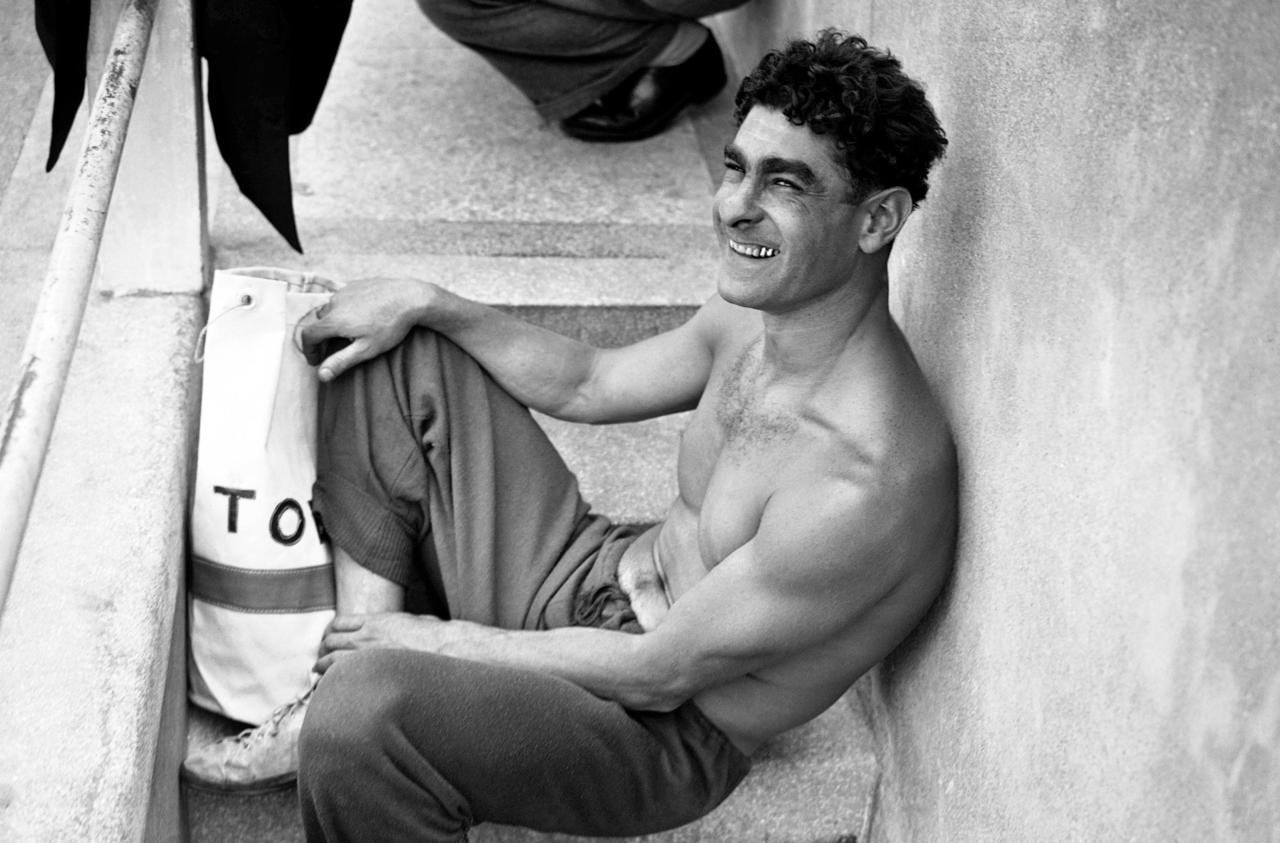
The reason Miailhe took creative license and chose to paint Nakache, one of the hundreds of Mizrachi Jews (of Middle Eastern descent) in France persecuted by the Nazis, with darker skin than he really had was to depict Jewish diversity.
At a time when Jewish identity is often misunderstood and you have 15 minutes to educate somebody (if you’re lucky), Miailhe took the liberty of painting Nakache as a Black Jew from North Africa. Although I consider myself knowledgeable about Jewish diversity, I wasn’t sure who was being called a dirty Jew in the Olympics scene (I went into this film not knowing anything about it). Though I knew who our protagonist was, I admittedly thought the victim was the white swimmer.
I found it jarring to see Nakache marching in a sea of light-skinned prisoners in the camp. It wasn’t an image from my Holocaust education. It left me with more questions than answers. It made me curious, like any good film should.
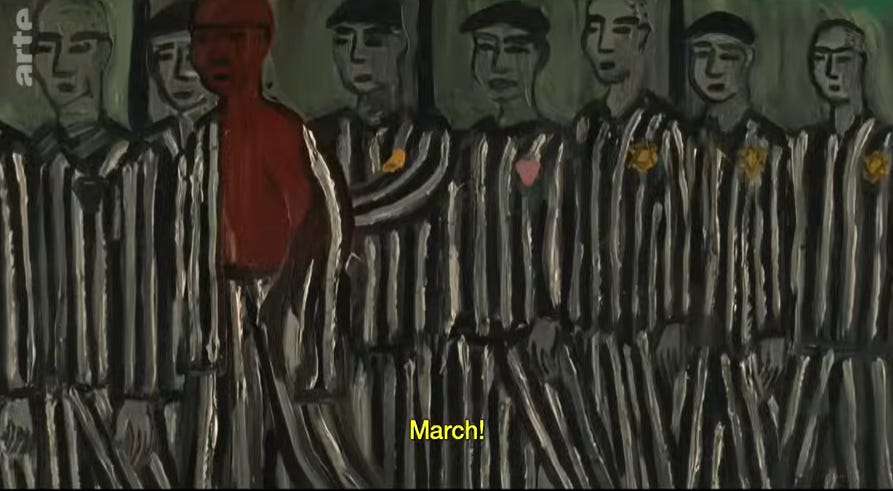
Miailhe, whose father knew Alfred and who learned to swim with his brother growing up, said in an interview: “I hope people will be moved by Alfred Nakache’s story and rediscover it, because it’s not well known in France. Also, we are living in some very troubled times in a world where racism and antisemitism are back.”
Was Miailhe right in exaggerating a historical figure’s skin tone to make a point? I’ll leave that for you to decide.
We watch, through vivid brushstrokes and bubbles, as Nakache falls in love and has a child, only for the three of them to be taken to Auschwitz and separated. There, the Nazis make “the swimmer of Auschwitz” dive into a freezing basin as punishment and humiliation.
He eventually is liberated in 1945, but his wife and child do not survive. Throughout his life, Nakache never stops swimming. He’s one of the first swimmers to perform the butterfly stroke, and returns to France to continue swimming, teaching children and reflecting on his life and lost family.
Nakache is the only competing Olympian before and after surviving the Holocaust (he competed in the London Olympics in ‘46), and one of the few athletes to compete in the Olympics after surviving the Holocaust (others include Polish weightlifter Ben Helfgott and Hungarian gymnast Ágnes Keleti).
Butterfly is a heartbreaking and inspiring work of art that portrays a lesser-known part of Holocaust history. It depicts diversity, a lifetime of courage, loss, and resilience in just 15 minutes, making it a short film you absolutely must see.
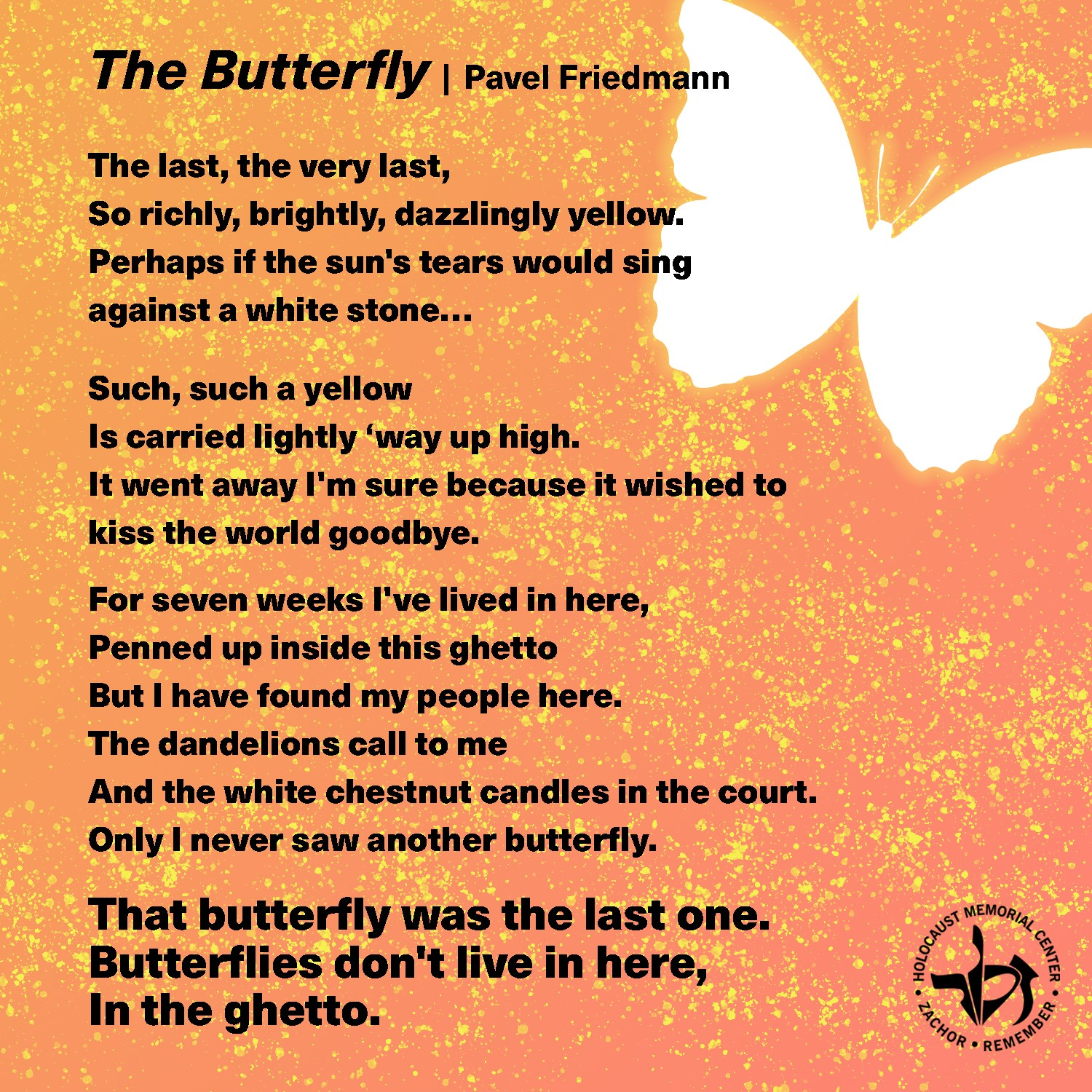
In keeping with the symbolism, I’m sharing the famous Holocaust poem “The Butterfly” by Pavel Friedmann, which he wrote at the Theresienstadt concentration camp in 1942. In 1944, he was deported to Auschwitz where he was murdered.
✨ Jewish Joy of the Week
This Facebook memory from the beginning of Covid, six years ago:
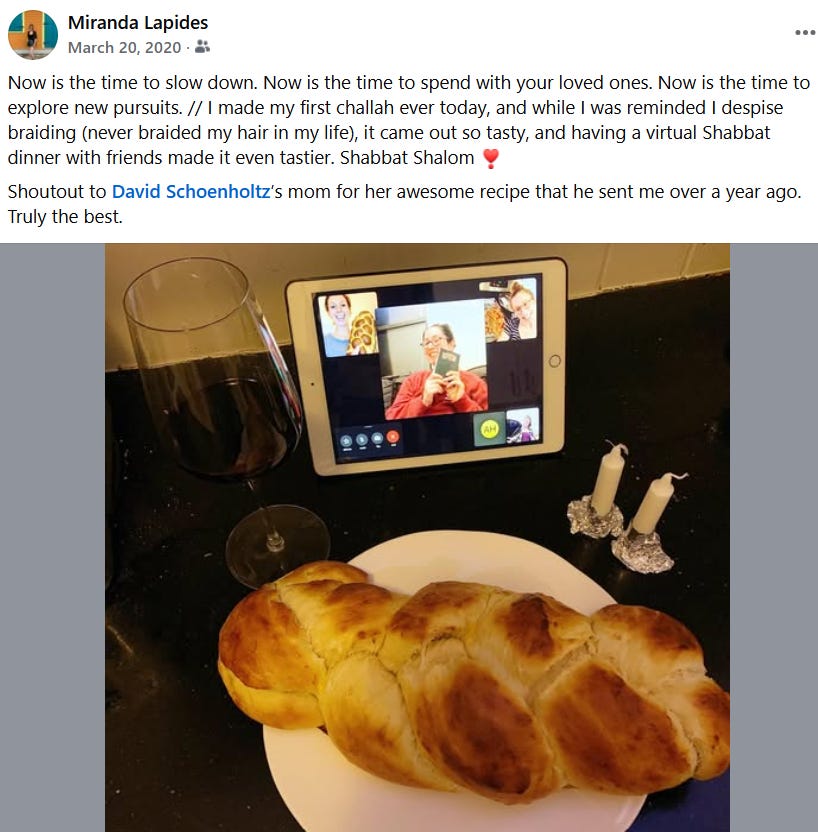
Shabbat Shalom! Here’s to in-person Shabbat meals,

💧If you’re interested in film, check out this Drop:
The Brutalist: A Blueprint for Jewish Survival

It’s rare to see a major motion picture centered on post-Holocaust life, especially one slated to win best picture. But Jewishness is merely a backdrop in this American epic that tells a story of power, the American dream, capitalism, and storytelling through art (or in this case, architecture).
You have outdone yourself on this drop. There are so many stories about the Jews in the Nazi camps that made music, were boxers and swimmers, but to latch onto the (forward by Chai Potok poem you have included, called the Butterfly), your readers should get hold of the book called I NEVER SAW ANOTHER BUTTERFLY, CHILDREN'S DRAWINGS AND POEMS FROM TEREZIN CONCENTRATION CAMP 1942-1944
I didn't know of the Bibas boys film, his poster got lots of attention. The world ignoring him after being a hostage and his eventual death should be a strong warning about antisemites. They're just as sinister as the Nazis and deserve a "Texas necktie party" to prevent other violent attacks. That poster became famous, it's in my SAR-EL documentary on Facebook.