

Hebrew Word of the Week:
I’ve been watching kids’ television shows in Hebrew. In one show, a boy called his hamster a zalan (זַלְלָן) katan, or a little glutton.
The Eurovision Grand Final is tomorrow at 3pm ET (you can stream it for free on this page!).
Why am I writing about this on a Jewish blog? Israel has been involved in Eurovision for the past 53 years, give or take. If you want a refresher on Israel’s history in Eurovision, read this ol’ Drop.
Which brings us to 2026, with 28-year-old Noam Bettan representing the Jewish State on the international stage in Vienna, aglow with flashy lights and flames (Eurovision is known not only for its catchy songs, but also for its over-the-top staging).
Noam’s set doesn’t include flames, but instead features a giant spinning diamond that he comes out of as he sings about a toxic love in French, Hebrew, and English. His song, “Michelle,” was co-written by last year’s Israeli participant, Yuval Raphael.
The song is an earworm, especially with the post-chorus “aye-aye-aye-aye-aye-aye oh-oh, oh-oh.” It’s such a bop, even the haters can’t help but dance along to it. Despite the shiny diamond, I find his performance to be lackluster compared to other acts. But you can really see he gives it his all, and I’m delighted he made it to the final.
Whatever you think of Israel’s performance, it’s always cool to see Jewish pride on international television. However, not everyone agrees. This year, five countries pulled out of the singing contest because Israel was participating. The automatic losers are Ireland, Iceland, the Netherlands, Slovenia, and Spain. So much for being united by music, which is Eurovision’s tagline!
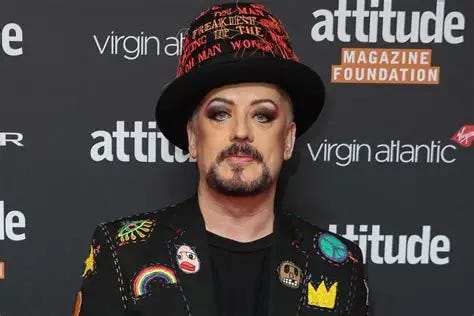
Boy George, who represented San Marino this year and didn’t make it to the final, believes music should unite rather than divide. Not Jewish himself, he has been outspoken on behalf of the Jewish community, and said: “It’s very trendy to hate Israel but I have always said ‘fashion for the fragile, style for the brave.’”
Obviously, he knows about style, just look at him……..
Another group contributing to the hate were our friends at the NY Times, who made a Very Big Serious Investigation (she said facetiously) into how “Israel turns Eurovision’s stage into a soft power tool.” No really. That was the headline. The article/”investigation”, however, revealed that Israel’s government - gasp - placed ads to encourage people in the diaspora to vote, as if any other country wouldn’t do that.
Participating countries make it to the final by getting the most votes. Last year, Israel received the most public votes, and in 2024, received the second most public votes. In recent years, I’m sure more Jews have voted for Israel just to show support and get Israel to the final. But how is that different from a Moldovan living in the U.S. voting for Moldova (which you all should, because Moldova’s song is amazing this year)? Like Hen Mazzig said on his Substack about the article, “When the Times accuses Israel of using Eurovision as a soft-power tool, it is accusing Israel of participating in Eurovision.”
All of this vote tallying and count obsession reminds me of this week’s parsha, Bamidbar, the first parsha in the book of Numbers. It turns out the Jewish people are just as obsessed with numbers and paying attention to who belongs.
The Israelites are preparing to leave Sinai and head toward the Promised Land, but not before Moses conducts a census of all the families who dwell alongside the Tabernacle, per G-d’s instructions. He counts men over the age of 20 in every tribe except for the Levites, who have their own special tasks in maintaining and carrying out the sacred Mishkan. Everyone counted is eligible for military service, and has the responsibility to defend and protect the group along their journey.
The census in Bamidbar recognizes who is present and willing to do their part in sustaining something sacred. Every person counted has a role in helping carry the community forward.
This is what Eurovision is to me: several countries, much like tribes, putting their differences aside and coming together to share a stage of sequins and song. The stage only works if people agree, even for a few hours, to enter into something larger than themselves, like how the Israelites put aside their complaining for once to enter into a holy transitional phase.
United by music sounds cheesy until you recognize the power of temporary dwelling. Whether that’s on stage or in the desert, community like that takes work.
May we all be united by music, and may “Michelle” finally get out of my head.
✨ Jewish Joy of the Week
I attended a class called “Torah After Dark,” taught by Rabbi Arielle Stein at Central Synagogue. It was a class on how Judaism views sex, pleasure, and longing, filled with a lot of Song of Songs and hiding under the bed. IYKYK.
Good Shabbos and good luck to Noam,

💦 If you like Eurovision or Jewish pride, check out these Drops:
🎤🎵Hallelujah! Israeli history through Eurovision wins
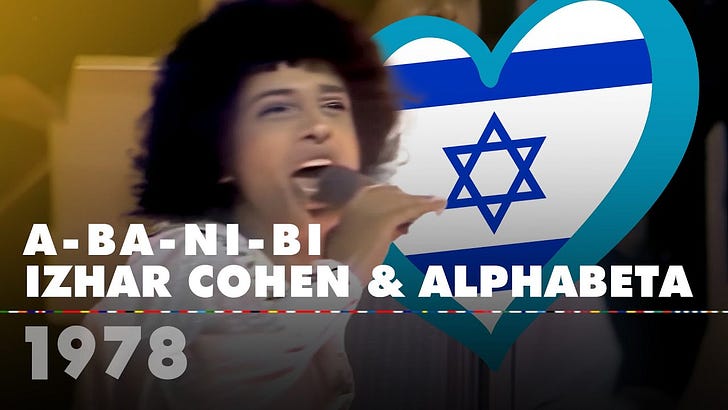
As a member of the European Broadcasting Union, Israel has been competing in the song contest since 1973, has won four times! So let’s change the mood even more by looking at Israeli history through its four winning Eurovision songs. Yalla!
A Middle Finger to Terror

This year is even more emotional, as Israel is being represented by a survivor of the Nova massacre. Yuval Raphael is a gifted singer. While “New Day Will Rise” is not my favorite song in the world, it feels amazing to cheer on a country that’s a part of your soul, akin to cheering for your team during the Super Bowl, I imagine.
Should we also be asking ourselves if “Cyprus” should be suspended from Eurovision?👇🏻🤔🫵🏻
https://unmappednarratives.substack.com/p/the-eurovision-double-standard?r=3knozv&utm_medium=ios
I feel bad about having dissed culture club when I was a kid (not really my style of music at all). Boy George is a real mensch.