

Hi!
You may have noticed there was no Drop last week (if not, I’m not offended). That’s because I’ve been pouring all my Jewish (and marketing) energy into an event my work hosted with Rachel Goldberg-Polin and Jon Polin, the parents of Hersh Goldberg-Polin, who was kidnapped and murdered by Hamas last year.
I’m so proud to have worked on hosting these two forces of hope with The Jewish Education Project at Temple Emanu-El’s Streicker Center. Hearing personal stories about Hersh reminded me to stay true to my values, and to continue learning Torah and striving to make the world a better place. If that’s Hersh’s legacy, what a legacy that is.
One of the ways I am continuing to learn is by attending Jewish classes, and I finally fulfilled my Jewish dream of learning at Lehrhaus! This Jewish house of learning and kosher restaurant (named one of the best new restaurants in the U.S. in 2023) is Somerville, MA’s hottest Jewish tavern of learning.
Lehrhaus was inspired by the 20th century Freies Jüdisches Lehrhaus (Free Jewish House of Learning) in Frankfurt, which served as an adult Jewish learning center for assimilated Jews.
Co-founded by the philosopher Franz Rosenzweig, the original Lehrhaus’s learning style was based on “a learning that no longer starts from the Torah and leads into life, but the other way round: from life, from a world that knows nothing of the Law, or pretends to know nothing, back to the Torah. That is the sign of the time.”
It certainly is a sign of the time that the Boston Jewish community was itching for a 21st century Lehrhaus!
I’ve been wanting to go ever since we interviewed the founder, Rabbi Charlie Schwartz, on The Jewish Education Project’s podcast, Adapting: The Future of Jewish Education (this is a Drop bragging about my work, I guess). Listening to a young, energized rabbi describe a place where Jews of all backgrounds can schmooze, grab a book off the shelf, attend a class, and enjoy a drink or a meal, had me hooked on his every word! For the first time in my life, I thought, “I must go to Boston.”
Two years after its opening, I finally went, attended two very different classes, and had a meal. Here’s this week’s Drop. It’s related to Chanukah, I promise :)
First, the ambience was exactly what I expected: cozy, buzzing with conversation, unpretentious, and intellectually curious. You’re greeted by shelves upon shelves of books, with comedically specific genre descriptions.
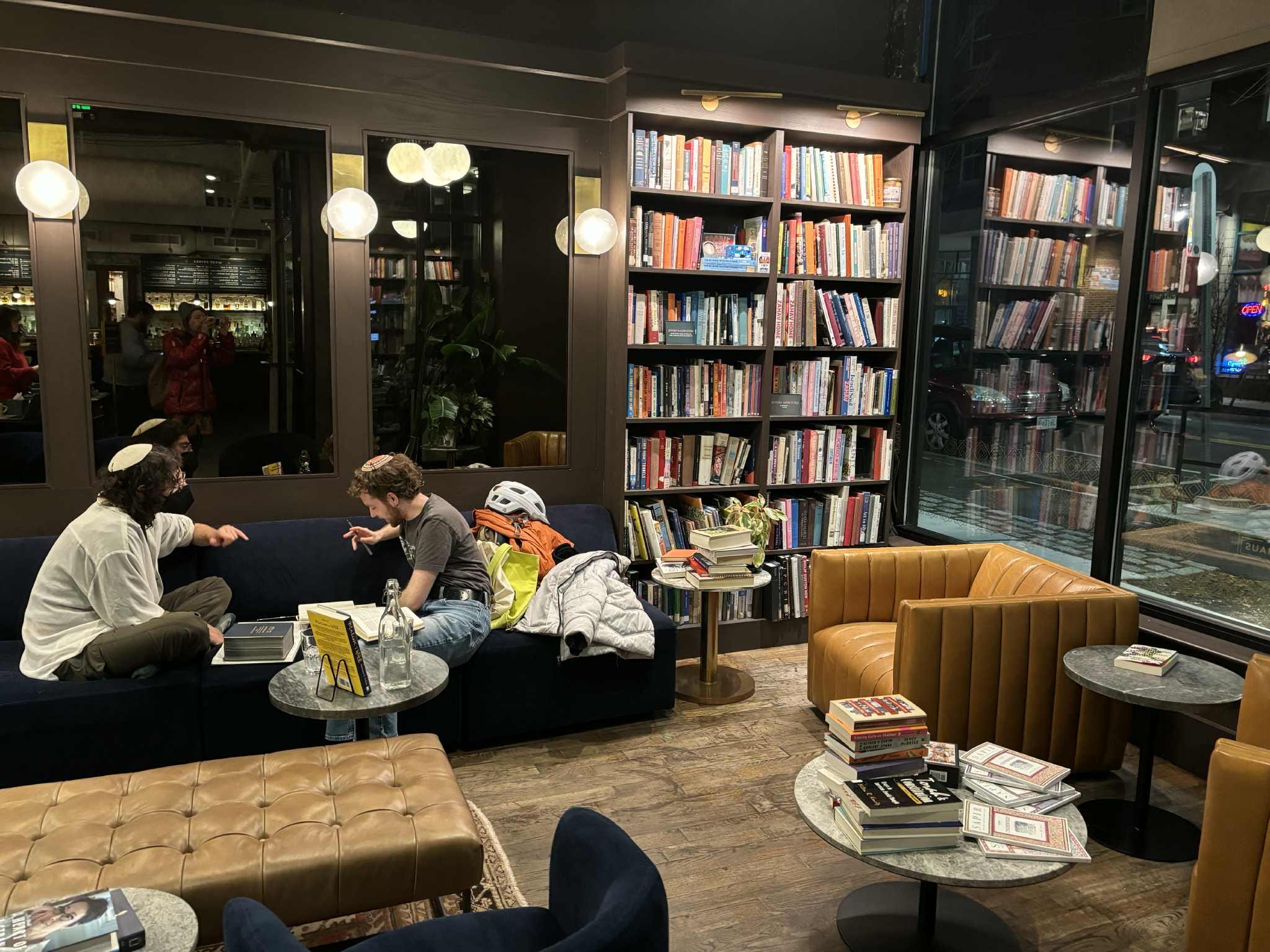
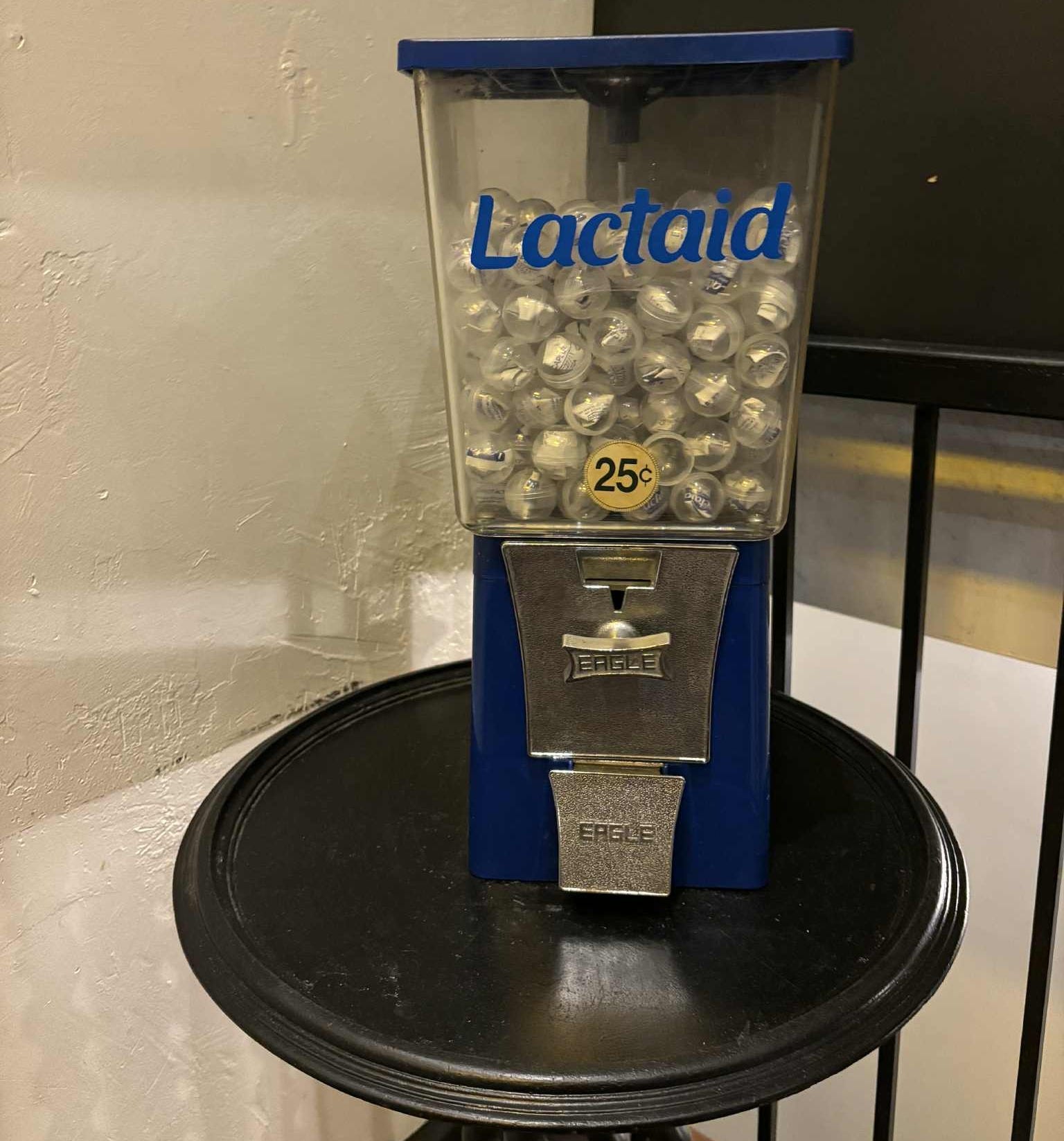
Being there made it feel like being Jewish is… cool. Which made me realize it doesn’t always feel that way. Let’s face it: Our faces are always in books. We celebrate our enemies not destroying us. We usually have stomach problems (there’s actually a Lactaid gumball machine, see below). Some of our rabbis and educators are desperate for us to connect to our identities, a little too much sometimes. And some of us are just plain weird.
But a vast and kickass Jewish book collection, scholarly deep cuts, a cutout of Hannah Arendt in the bathroom, various Jewish heroes depicted on the walls from Emma Lazarus to the guy who cleans the notes out of the Kotel, and a cocktail with pistachio arak in it (I’m getting ahead of myself)… it made me feel cool. Energized. Proud to be Jewish.


Class 1: Early Days of the Diaspora
My first class of the evening was called, “Who Invented the Diaspora?” and was taught by scholar Dr. Malka Simkovich. To be honest, it took me a good 20 minutes to settle into the class mentally, as my mind was buzzing because I was finally at Lehrhaus and I wanted to explore every nook and cranny!
But here’s my takeaway: The word diaspora first appears in the ancient Greek translation of the Bible (called the Septuagint, from 250–150 BCE). The word was used to describe the dispersion of the Jewish people, but get this: it was used to replace the word “horror” in Devarim 28:15-68:
The Lord will cause you to be defeated before your enemies; you shall go out against them one way and flee before them seven ways. You shall become an object of horror to all the kingdoms of the earth.
The Septuagint replaced “object of horror” with “be in dispersion,” a made-up Greek word for horror. This proves that the word diaspora was never intended to be a neutral word.
I found this insight particularly interesting, because there has been a pro-diaspora movement in the last couple of years to try to disconnect Jews from the land of Israel and to paint the diaspora as puppies and rainbows. While I think aspects of the diaspora are interesting and beautiful, like how Jews ended up in India of all places, we were never supposed to end up here in the first place. The heart of Jewish peoplehood is centered in Israel. We pray for a return to Zion and celebrate holidays rooted in the land. We only left because we were exiled. Also, it’s privileged to think the diaspora is safe for all Jews. That’s not to say Israel is puppies and rainbows (it’s more like dirty cats and intense heat). We could get into a debate on this, but that’s a whole other Drop!
To continue this tangent, I recently attended a lecture where the speaker argued that because old Jewish manuscripts reflect symbols of their societies (like a 17th-century ketubah from Italy decorated with naked women in the Italian style of the period), the Jews of that time must have lived rich and fulfilling lives. However, it was later revealed that it wasn’t the Jews who created their own manuscripts. Why, you ask? Because they weren’t allowed to. Some rich communities they were a part of!
🕎 Here’s where the class ties into Chanukah!
In this class, we also read excerpts from 2 Maccabees, containing possible letters from 124 BCE written by Jews in Jerusalem to Jews in Alexandria, Egypt. In them, the Jerusalem Jews implored the Alexandria Jews to celebrate what would later become known as Chanukah, only they call it “the festival of booths in the month of Chislev,” since Chanukah was originally a late celebration of Sukkot (that’s why we get eight days of jelly doughnuts!).
Keep in mind, these writings took place just 40 years after the Maccabean defeat of the Seleucids and the rededication of the Temple. Still, the text sounded so urgent and desperate to have Jews outside the land honor the “Purification of the Temple” out of fear of Jews becoming obsolete. Those Alexandria Jews probably thought that the defeat of the Seleucids didn’t affect them, so why should they care? If only they knew the delicious fried foods their descendants would one day enjoy!
For a holiday that’s now one of the best known to non-Jews thanks to its proximity to Christmas, and one that’s celebrated by Jews all over the world, from Gaza to Hong Kong, it was interesting to read about a fear of it becoming forgotten so soon after the events took place.

Class 2: Dream Circle
If the first class was scholarly and historical, the following class was mystical and Freudian. Deliciously different, in a good way!
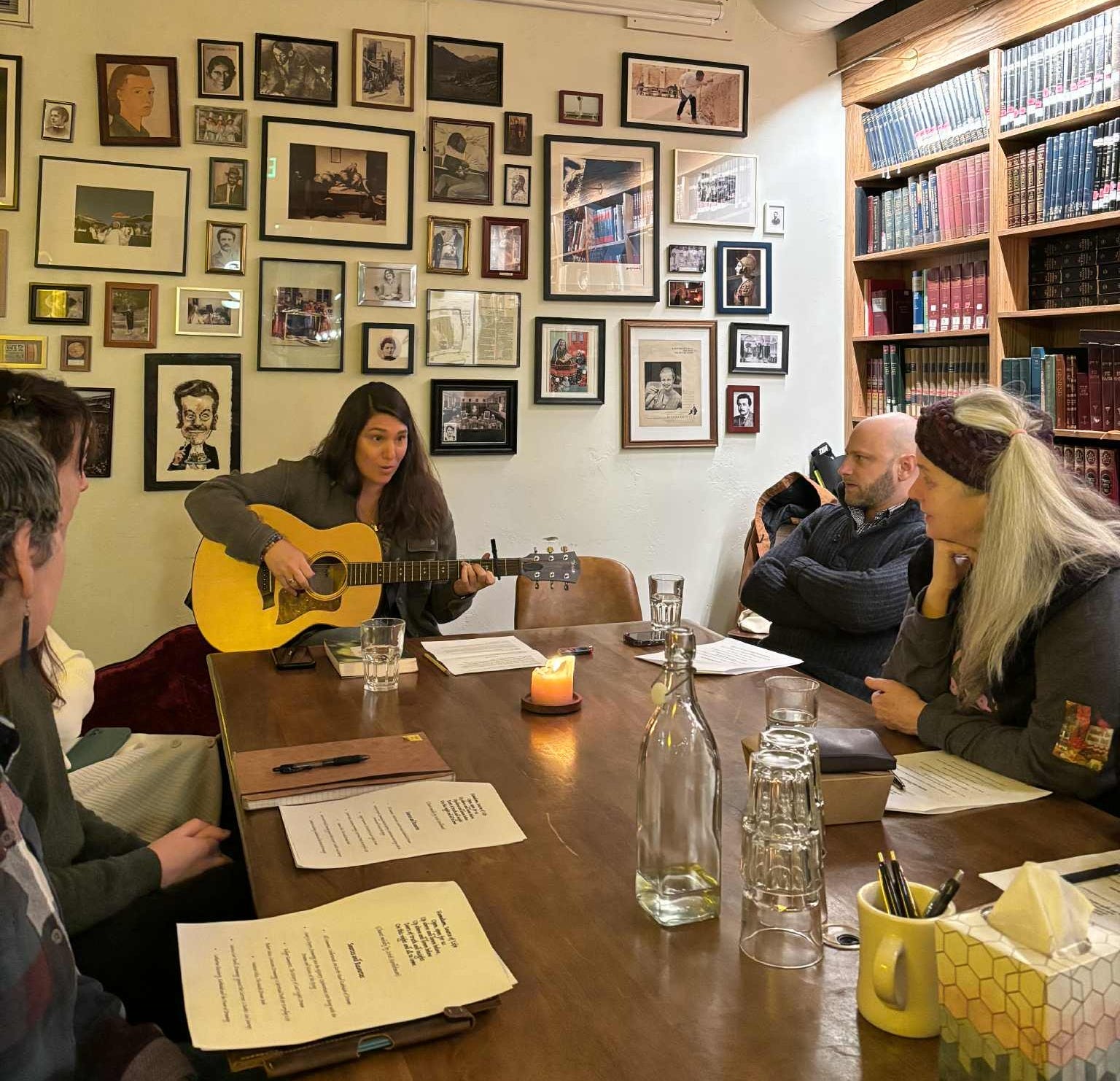
Ariel Hendelman led “Up Above & Down Below: Dreaming in the Jewish Tradition.” Using a framework for interpreting dreams from Jill Hammer’s book, Undertorah: An Earth-Based Kabbalah of Dreams, Ariel led us in a session to interpret our recent dreams together! Here’s how the framework goes:
The dreamer shares their dream in the present tense, as if they are living it in the moment. They describe as many details as possible without trying to interpret it themselves.
After they’re done sharing their dream, members of the circle ask clarifying questions about the dream, so they have as many details as possible.
Then the circle is open to interpretation. Each person starts with, “As a dreamer of this dream…” as if the dream is their own, and they share their perspective or any insights.
Here’s an example:
A man shared his dream of being in the backseat of a car while his dad, who is no longer living in real life, is driving. His mother, who is also no longer living, is in the passenger seat. The dreamer realizes they are running low on gas and his father doesn’t notice, but his mother does and sees a gas station.
We asked questions like, “What kind of car is your father driving?” “Where in the backseat are you sitting?” “Are you younger, or are you your age today in the dream?” The dreamer tried to answer our questions as best as he could.
Then people gave their interpretations: As a dreamer of this dream… “I feel protected by my parents, knowing they’re taking care of me.” “I feel like I’m the parent for noticing the gas running low, and my father is the child.” Someone even related the dream to that week’s parsha, comparing his father to blind Isaac and his mother to Rebecca who swoops in and takes care of business.
It was honestly therapeutic and eye opening, as some people shared interpretations that the dreamer may not have thought of before. One woman said she was grateful for an insight I shared about her dream.
Food, and the Diaspora Again (No Tangent This Time!)
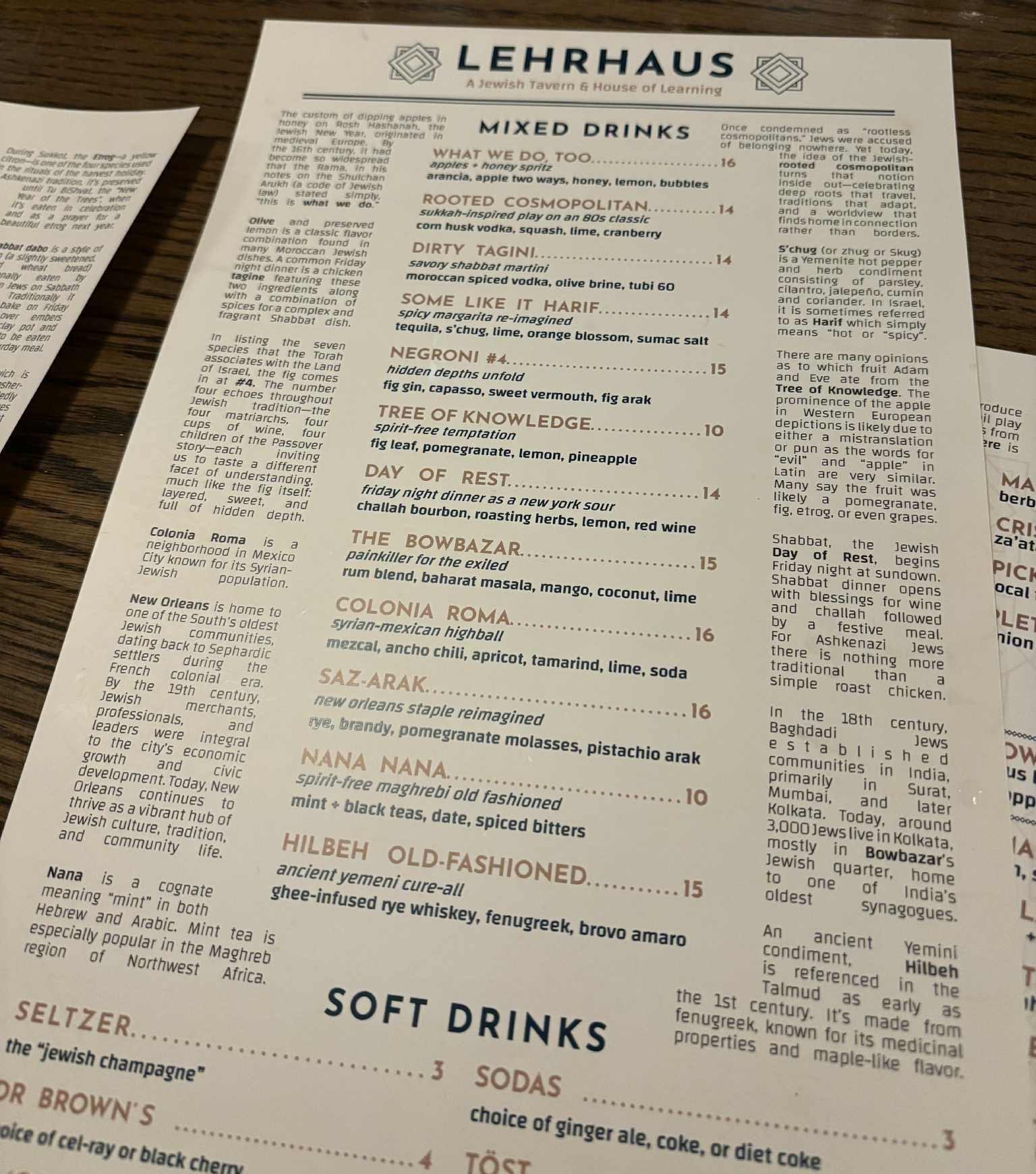
Lehrhaus’s cocktails, which are displayed on a menu designed to be a page of Talmud, are creatively themed and crafted. I already teased my delicious Saz-Arak. I would go back just for the drinks!
For dinner, we ordered the pickle plate to start, the famous beet Reuben, and fish and chips. The food menu is also designed as a page of Talmud, and gives fun facts like where the Reuben sandwich was first documented (the Cornhusker Hotel in Lincoln, Nebraska), and tidbits about the Brazilian Jewish community.
This menu circles back to the diaspora discussion, a reminder that Jewish food is made up of the many journeys of diasporic Jews. We wouldn’t have this eclectic menu, which includes fish and chips (from Sephardic Jews fleeing Spain), and pletzl (Ashkenazi flatbread from Paris, meaning “little square”) otherwise.
I got a kick out of (quite literally) the amba vinaigrette and the spicy s’chug aioli that came with the fish and chips. Aside from that, I didn’t think the food was as good as the learning, but I don’t go to Boston for the food ;)
My much-anticipated Lehrhaus visit lived up to the dream. And just like Joseph in this week’s parsha, you never know where your dreams will take you. They just might take you to Boston… or DC! Which is where Lehrhaus is looking to open next. As someone who was once very active in the Jewish DC scene, it will be a great addition there.
Shabbat Shalom / Happy Festival of Booths in the Month of Chislev!
May your Jewish dreams come true,

Shabbat Prompt ✍️
What ARE your Jewish dreams? To have a b-mitzvah later in life? Finish studying a tractate of Talmud? Memorize a specific prayer? Raise a Jewish family? Host a Seder? Finally go on that Jewish trip to India? Feel free to share in the comments!
Wow! I didn’t know ANYTHING about that! Happy Chanukah 🕎
Always good articles, Miranda could be a professor on Judaism. She inspired me to buy "Exodus " and "Mila 18", both by Leon Uris. He and Herman Wouk were on book shelves when I was a kid. Elie Weisel's Night was too, but it was tough reading. Miranda, you're always good reading, many congrats.