

Happy Friday! For those in the U.S., I hope you had a delicious Turkey Day. Or Pie/Mashed Potatoes/Mac n Cheese Day instead because turkey is gross (and not even originally considered kosher!).
Hebrew fun fact before diving into this week’s Drop: The Hebrew word for “Jews,” yehudim, comes from the root of the Hebrew word hodu, or “to give thanks.” It’s also Hebrew for “turkey."
Now that I got that out of my system… if you know me, you know I’ve gotten into the mysterious world of tarot in the past year after I had a powerful reading.
People have misconceptions that tarot is used as fortune telling, which is how it can be used. But another more practical, less witchy way to use the cards is by using its specific imagery to look inward and see how you can apply the cards’ messages to your own life. Like a Rorschach test for interpreting your life, but the imagery is clearly a naked child mounted on a white horse… or Taylor Swift, or cats, depending on which deck you’re using! And that’s supposed to symbolize happiness.
I, at least, don’t take that to mean, “You will find happiness.” Rather, I reflect on the areas of my life that already leave me feeling content. And the more cards you pull, the more you can tell a story with those cards about your life. It can be therapeutic and clarifying.
Now that I’ve totally sold you on tarot, here’s where it gets even more mysterious.
Last Shavuot, I attended the most fascinating lecture that totally sold ME on the tarot having Jewish connections!
The most obvious is The Wheel of Fortune card, which contains the Hebrew letters יהוה for the Tetragrammaton, the name of G-d. And the 22 Major Arcana cards represent the 22 letters of the Hebrew alphabet!
Stav Appel’s riveting 2am class explained the possible origins of this Jewish connection. The Jean Noblet Tarot de Marseille deck was made around 1650 in France, during a 250-year ban on public Jewish life (thanks, King Charles).
Crypto-Jews had to find a workaround and get creative to practice Judaism… like teaching through tarot cards. It’s one of the few times in history you could call Jews sneaky and mean it as a compliment!
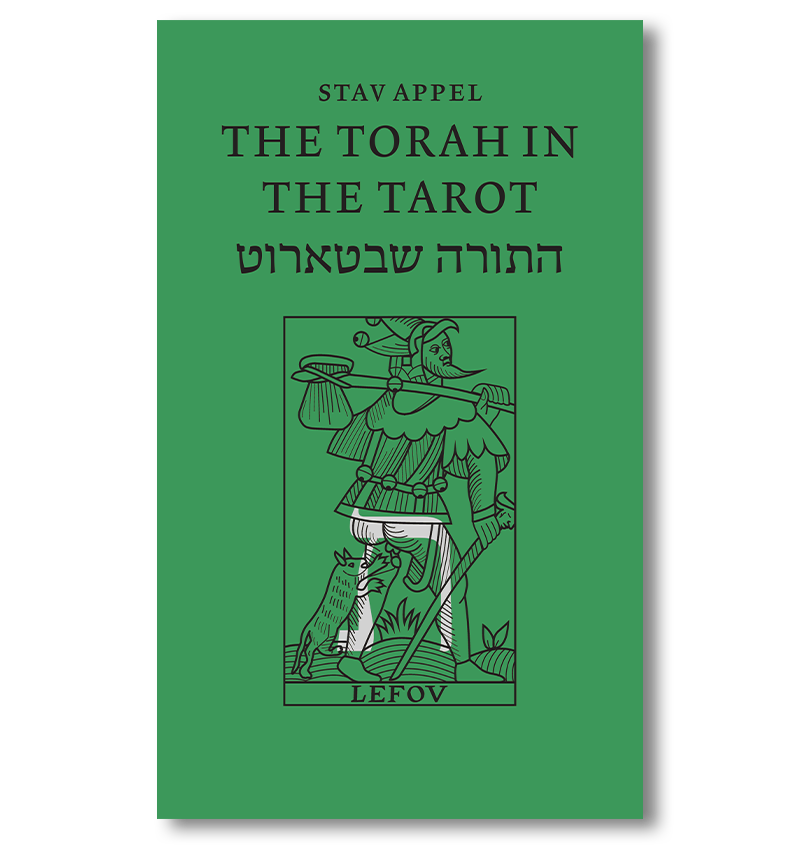
When you study the Noblet deck through a Jewish lens, it starts to look like way more than just a set of cards. Hidden in the art are Hebrew letters, Torah stories, ritual objects, and even the Jewish calendar. It’s like a secret textbook for underground Jewish learning. And I’ve been waiting five months to write about it, because his book, The Torah in the Tarot, just came out!
In honor of the 100th anniversary of Jewish Book Month, I’m sharing what I’ve been calling my favorite thing in Judaism lately.
A Brief History of Tarot
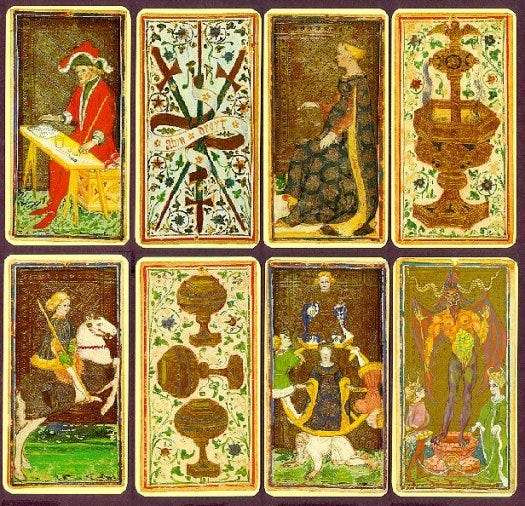
The original deck comes from 15th-century Italy, when it was used as a card game called trionfi and was purely for entertainment.
Then, in 17th-century France, it evolved into the Tarot de Marseille deck. Its glow up included sharper and more symbolic imagery, closer to the standardized tarot imagery of today.
In early 20th-century London, tarot reinvented itself again, thanks to illustrator Pamela Colman Smith. Her 1909 Rider-Waite-Smith deck added full scenes to the Minor Arcana for the first time, making the cards accessible, story-driven, and ripe for intuitive reading. The RWS deck basically set the standard for every modern deck you see today.
Okay, but how is it Jewish?
The Jean Noblet deck is the oldest deck in the larger 17th-century Tarot de Marseilles collection. Stav, data scientist by day, just happened upon a copy and noticed many biblical references in the imagery.
When he took a closer look at all the cards, he noticed symbolism and connections that were too numerous and specific to be coincidences. His book, which includes a copy of the deck, breaks down each of the 22 Major Arcana cards and explains their Jewish connections. When you read it, you too will be thoroughly convinced that this deck was once a vessel for Jewish teaching and wisdom, getting a glimpse into crypto-Judaism of post-Renaissance France.
Video by OhrJudaica
Convince me. Give me an example.
Time for a lil D’var Tarot! The Lovers card aligns perfectly with this week’s parsha, Vayetzei.
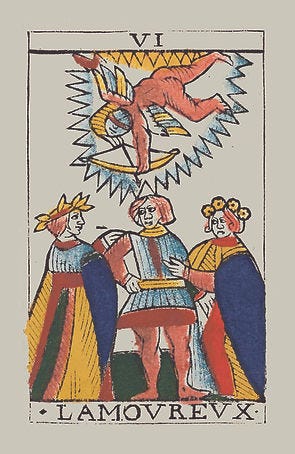
There’s three people in The Lovers card. In the original Italian Tarot deck, The Lovers had two people on it. Then, the Marseille deck’s Lovers card suddenly featured three people, possibly representing Jacob (in the middle), Rachel (with her hand on her heart), and Leah (on the left).
In this week’s parsha, Jacob falls in love with Rachel, Laban’s daughter, and wishes to marry her. Laban agrees to the marriage, but tricks Jacob into marrying his older daughter, Leah, after seven years of labor. In exchange for another seven years of work, Jacob marries Rachel. Jacob has eight sons with Leah (two with her maidservant), and four sons with Rachel (two with her maidservant).
No wonder the 20th-century Lovers card reverted to its original depiction of two lovers; three leads to 14 years of labor!
Not convinced? Check out the headpieces on each woman’s head. They’re mandrake roots, which were used for fertility back then. Leah has eight on her head (two hidden for Zilpah’s sons). Rachel has four on her head (two less prominently placed for Bilhah’s sons).
We’ve got more insight into the Torah’s messiest love triangle! Each Major Arcana card in the Noblet deck represents a Hebrew letter. The sixth card, The Lovers, represents the sixth letter of the Aleph-Bet, vav. See the red line going down Jacob’s torso? Vav signifies “and” in Hebrew. It also represents connection or union, like Jacob in union with Rachel and Leah, like the ladder in his dream connecting heaven and earth, and like his choices connected to his legacy (Rachel’s son = Joseph, our next Torah hero!).
Still not convinced? Notice the angel above his head? That’s the angel Jacob wrestles with in the next parsha, who gives him—and all the Jews after him—the name Israel.
I could give you more chilling examples, like how The Hanged Man represents Haman, the villain of the Purim story. The Magician represents a mohel, the rabbi who performs a bris. And the Sun’s imagery of two people in front of a wall represents Shabbat, with 39 bricks in the wall for the 39 melachot, or categories of labor forbidden on Shabbat. There are so many examples of hidden Judaica on each card. You just have to see for yourself!
Stav’s compelling book makes a great Chanukah gift for that spiritual, mystical Jewish friend, or anyone who loves Torah.
Shabbat Shalom! Thankful for you,

I’ve been thinking of ordering this. Thanks for the review and example.