

Hebrew Word of the Week:
Ever think a thought and realize you accidentally said it out loud? This week, my colleague caught me muttering Hebrew verbs to myself to make sure I know the difference between mechapes (he is looking for) and mesachek (he is playing). Good thing that’s all I said out loud!
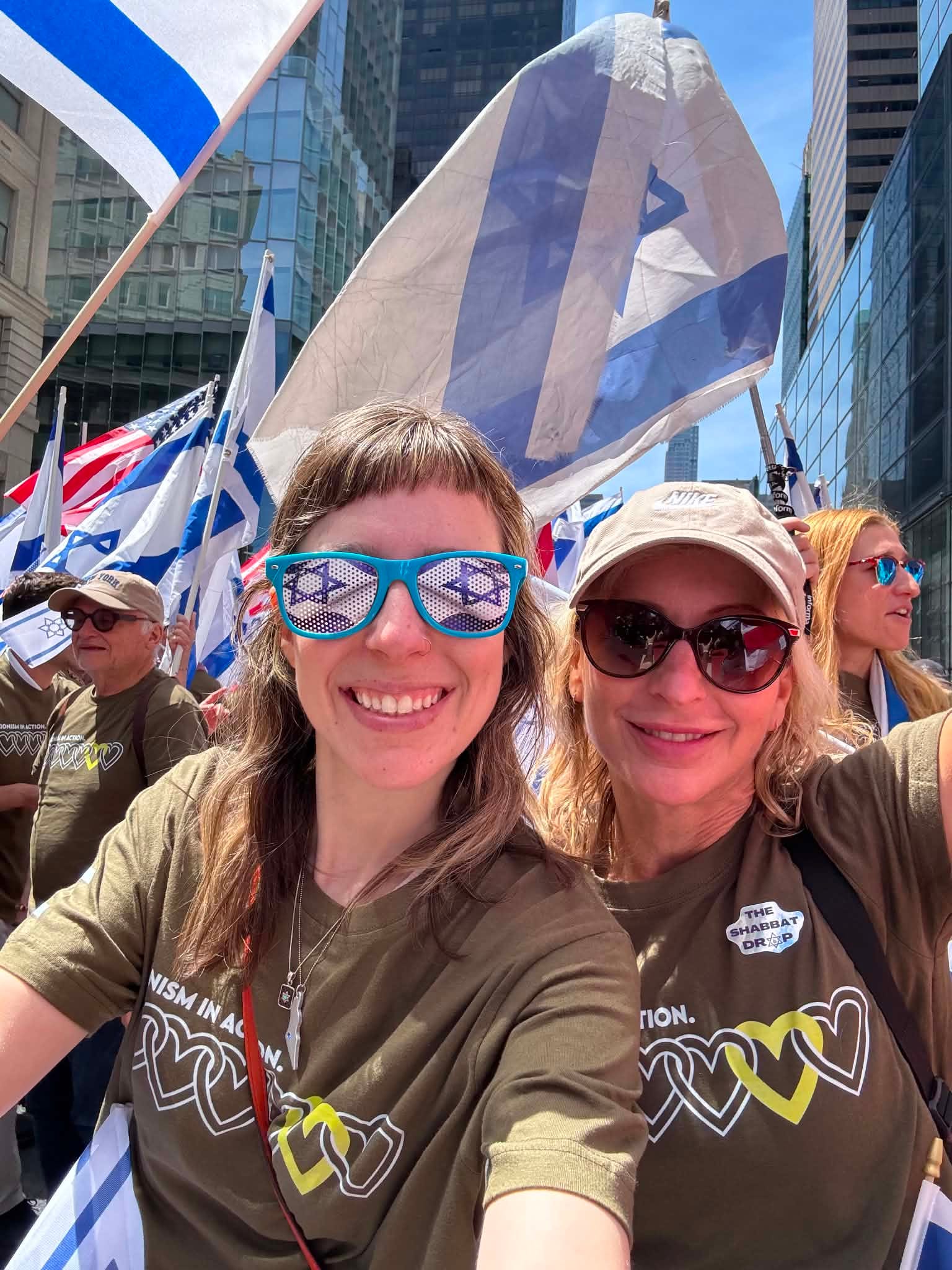
Who was at the Israel Day Parade on Sunday? 🙋🏻♀️ One Israeli commented that it felt like Israel’s Independence Day. Because that’s what it was celebrating! No politics1, no agendas, no mayor2… just joy, pride, and strength!
Speaking of Israel, I can’t believe it’s been a year since I was “stuck” in Tel Aviv during the 12-Day War with Iran.
That trip had such a lasting impact on me. I mostly stopped eating shellfish and pork (a big deal for me!). I pray more. My Hebrew has vastly improved because I was inspired to keep studying. And I met the most amazing, passionate people.
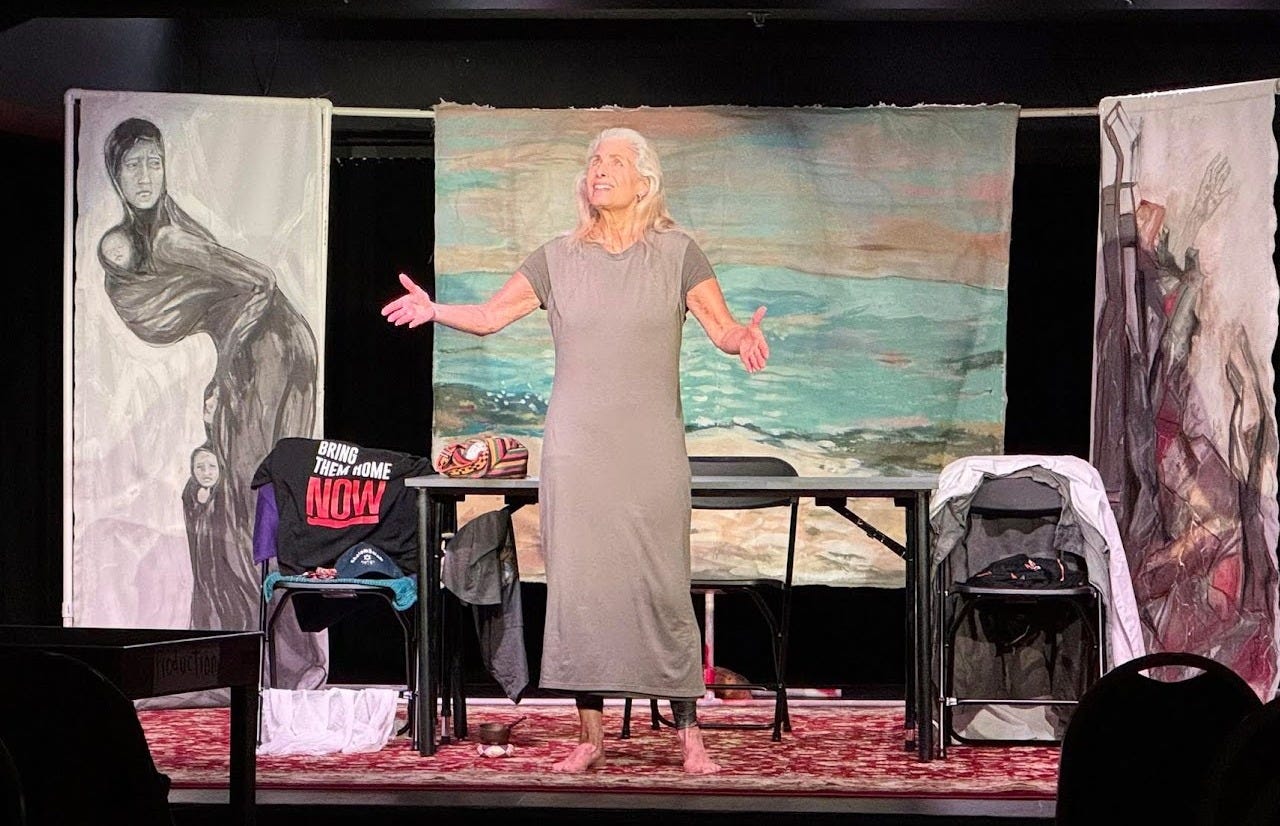
One of them was Sandra Laub, who I met between sirens at the Maxim Hotel. Sandy is a playwright from Connecticut. Her one-woman play, Picking Up Stones: An American Jew Wakes Up to a Nightmare (produced by Jerry Fischer), is showing at the Midtown International Theatre Festival here in NYC at the end of this month and early July. This is my attempt at convincing you to see it!
The Premise
Just as the title depicts, Picking Up Stones features an American Jewish woman waking up on October 7th to find herself unable to make sense of the world she thought she understood.
Throughout the play, Sandra plays 21 characters, some real and some composites. They include her real Israeli cousins, Palestinian mothers, Golda Meir, a peace activist burned alive in her own home on Kibbutz Be’eri, and a college student called a ZioNazi by her progressive friends.
But most of all, she plays herself, wrestling with a complex reality on stage. The conversations of multiple truths thread together without being neatly resolved.
Its onstage debate-like style reminds me of Itamar Moses’s The Ally starring Josh Radnor, about a Jewish college professor who initially agrees to sign a student's manifesto addressing police brutality, until he sees language in the document criticizing Israel that unsettles him, forcing him to question his identity and faith. The professor has charged conversations with all sorts of diverse characters. During these conversations, he becomes more of a “receiver,” reflecting everyone else’s views and beliefs.
But in Picking Up Stones, the audience is the receiver, as viewers grapple with voices of the angry, the hurt, and the grieving, all skillfully played by Sandy. Even the stones play a role; sometimes they build and support, and other times they weigh heavy on a tombstone.
In just 80 minutes, the play covers a range of topics, like the assumption that all Palestinians want Israelis killed, the blockade of Gaza, the question of how the West can wish for Palestinian statehood when some Palestinians don’t even want it… unless all the Jews are gone, how Arab neighbors don’t want to take in Palestinian refugees, young Israeli men dying for a state, and how peace should not be such a radical idea.
“I wrote Picking Up Stones because October 7 shattered assumptions I had carried most of my life as an American Jew. I found myself struggling to wake up from a nightmare that seemed chaotic and tangled beyond any rational solution or knee-jerk position. I felt trapped in a web of grief, fear, love for Israel, concern for innocent Palestinians, and a growing sense that the conversations I needed to have weren't happening. I saw a lack of empathy on 'each' side.
Theater thrives on conflict, so I wrote dialogue for the humans involved in this, what seems like a watershed historical moment. Theater became a place where I could wrestle publicly with those questions. The play is my attempt to make sense of a moral and emotional earthquake, and to invite audiences into a deeper, more human conversation across division. My play isn't like listening to a podcast or reading a book or an article or op-ed. It's a real-time journey of grappling, of awakening - a personal, Jewish, moral and emotional reckoning that happens in public and that eschews easy or one-sided answers to the questions haunting me, and perhaps the audiences coming to see my play. The talkback after every performance offers that opportunity.” -Sandy
To Be a Better Zionist
Like any country, Israel is far from perfect. Its hawkish right-wing government is corrupt and needs reform. Settlers in the West Bank are terrorizing Palestinians. The exemption of Haredi men from military service remains a significant and contentious issue.
While I understand the discomfort of publicly naming these issues in non-Jewish spaces, too many of us are in denial about what is going on even in Jewish spaces because we think Israel can do no wrong. But naming these issues makes us better Zionists, better Jews, and better humans. And not only naming, but wrestling with. Like Jacob and the Angel, it’s just what Jews do.
Throughout the war, I supported Israel’s goals of rescuing hostages in Gaza and dismantling Hamas. A war was waged against her on October 7th, after all. But like any war, it came at a cost in civilian lives, and destroyed homes and livelihoods.
I also disagreed with some of Israel’s actions, like withholding aid to pressure Hamas, and shooting civilians trying to get food once it arrived.
And I know some of you are shouting behind your screen at me, “But Hamas was stealing aid!” and “It was proven there was no famine in Gaza!” or “Soldiers shot at people because a mob was forming and it was getting dangerous.”
Believe me, as an educated Zionist I get the instinct to doubt what you see in the media. To justify and provide facts and statistics. During those intense and difficult two and a half years, it was all I was doing.
But that's not the conversation this play is having.
Picking Up Stones leaves no room for whataboutism, statistics, or competing narratives. It carves space for us to sit and acknowledge pain, and to think about how we can learn to love our neighbor as ourselves, even in complicated times.
“To be a Jew means you care about that 4-year-old Palestinian as much as you care about the 17-year-old Israeli who doesn’t.” -Picking Up Stones
Loaded Lines
There are lines in the play I downright disagree with. At one point, an American high school teacher says: “I am wrestling with how to stay Jewish since Israeli policies have become so extremist, racist, fascist, corrupt.”
While I agree about the Israeli government statement, I disagree with the idea of doubting your Jewish identity as a reaction to Israel.
Does that line also strike a nerve? Do you agree with it? Do you find yourself somewhere in the middle, thinking, “I have no problem being Jewish, but it’s Zionism that I’m questioning”?
Even a single line like this can open up so much for a conversation, like discussing the different types of Zionism, Jewish values (like tikkun olam and prioritizing Jewish defense), and what people mean when they use these terms. Picking Up Stones favors nuance and dialogue rather than tearing down hostage posters or generalizing an entire people.


One of my favorite lines is during a conversation with Vivian Silver, the peace activist killed on October 7th, and Golda Meir, Israel’s first female prime minister who was criticized for her leadership during the Yom Kippur War.
Vivian says idolizing the state over the lives of our neighbors is a sin we can't atone for, that it's a burning bush that will consume us. Golda fires back: "By the way, when's the inquiry? I had an inquiry for my war."
Oof! Sassy Golda. As these two women speak across decades, history comes alive, making the present feel even heavier.
If you care about these conversations, please join us on one of the dates below. I’m also organizing a group discussion after the June 28th performance. Group ticket discounts are available, so bring your friends or your congregation!
And if none of this makes you want to see the play, then maybe this will: There’s a line in it inspired by something I wrote in my 12-Day War Drop! Can you guess what it is?
Show times:
Friday, June 26 6:00-8:00pm
Saturday, June 27 7:30-10:30pm
Sunday, June 28 1:00-3:00pm with post-show Shabbat Drop discussion!
Thursday, July 2 7:45-10:45pm with talkback moderated by Brandon Levy, CEO of Sustainable Ocean Alliance
Friday, July 3 7:15-9:15
Saturday, July 4 1:45-3:45 with talkback moderated by Dr. Ellen M. Umansky, the Carl and Dorothy Bennett Professor Emerita for Judaic Studies at Fairfield University, CT
Shabbat Shalom. Here’s to peace,

💦 If you want peace, check out these Drops:
How do you feel about Israel@75?

I’ve been thinking about my own relationship with Israel lately, how my views have shifted slightly throughout my Jewish journey, starting with receiving education from right-leaning organizations, to broadening my views by reading more perspectives. I asked people how they felt about Israel's birthday.
Creating Change, One Milk Carton at a Time

An uplifting story that happened to my friend with her local Muslim bodega owner during the Israel-Hamas War.
I know some of you are thinking, “But Miranda, Israel is inherently political.” Sure. But at this parade, a Trumper was marching side-by-side with a leftist Zionist who believes in Palestinian statehood. No politics were mentioned.
Why would we want him anyway?!
Thanks for another great Drop. Sounds like a very interesting concept, but sometimes I wonder why it's always and virtually only us Jews who engage in the introspection and self-examination. Show me a substantial movement of Palestinians and other Arabs and Muslims doing anything remotely similar (I know, there are several brave individual exceptions, but their exceptionalism proves my point).
Isn't this exactly the root of this whole conflict for the past 100 years? And the rare Arabs who wanted to coexist peacefully were either bullied or even murdered by their hard-line compatriots.
Imagine Sandra trying to do this play from the Palestinian Arab perspective. Her 21 characters would be 1 person saying "yes, the Jews stole our land, but I'm tired of war" and 20 people saying "from the river to the sea."
Wow - sounds like the play will be an amazing experience for the audience members. An extremely well done overview of the play especially because of the intricate interweaving of emotions, issues and characters - a complex tapestry of heart wrenching and controversial threads that you present so thoughtfully