


Hebrew Word of the Week:
Pumpkin spice is tavlin dela’at (תבלין דלעת), though I’m not sure there’s much of that flavoring in Israel!
✨Welcome to a world of castles in faraway lands, of witches with razor-sharp teeth riding dragons, and of brooding men with dark auras and large wingspans!✨
This week, The Drop is bringing romantasy to your inbox. We’ll cover three topics on this beautiful Friday:
🧚🏻♀️Jewish themes from the most popular series, A Court of Thorns and Roses.
🧚🏻♀️The antizionist backlash that this series and other prominent romantasy authors have received.
🧚🏻♀️Bonus content for paid subscribers: Jewish fantasy recs!
Romantasy 101
Romantasy (romantic fantasy) is a popular literary subgenre of fantasy fiction in which romance plays a prominent role alongside world building, magic, and adventure.
Classic tropes include fae (fairies), dragons, witches, vampires, morally gray characters, and dark academia. Books can be very sexual, aka “spicy”, or not at all.
Since 2022-23, romantasy has grown in popularity and hasn’t stopped. Earning $610 million in global book sales in 20241, its readers are mostly women between the ages of 20-34. I am one of those women.
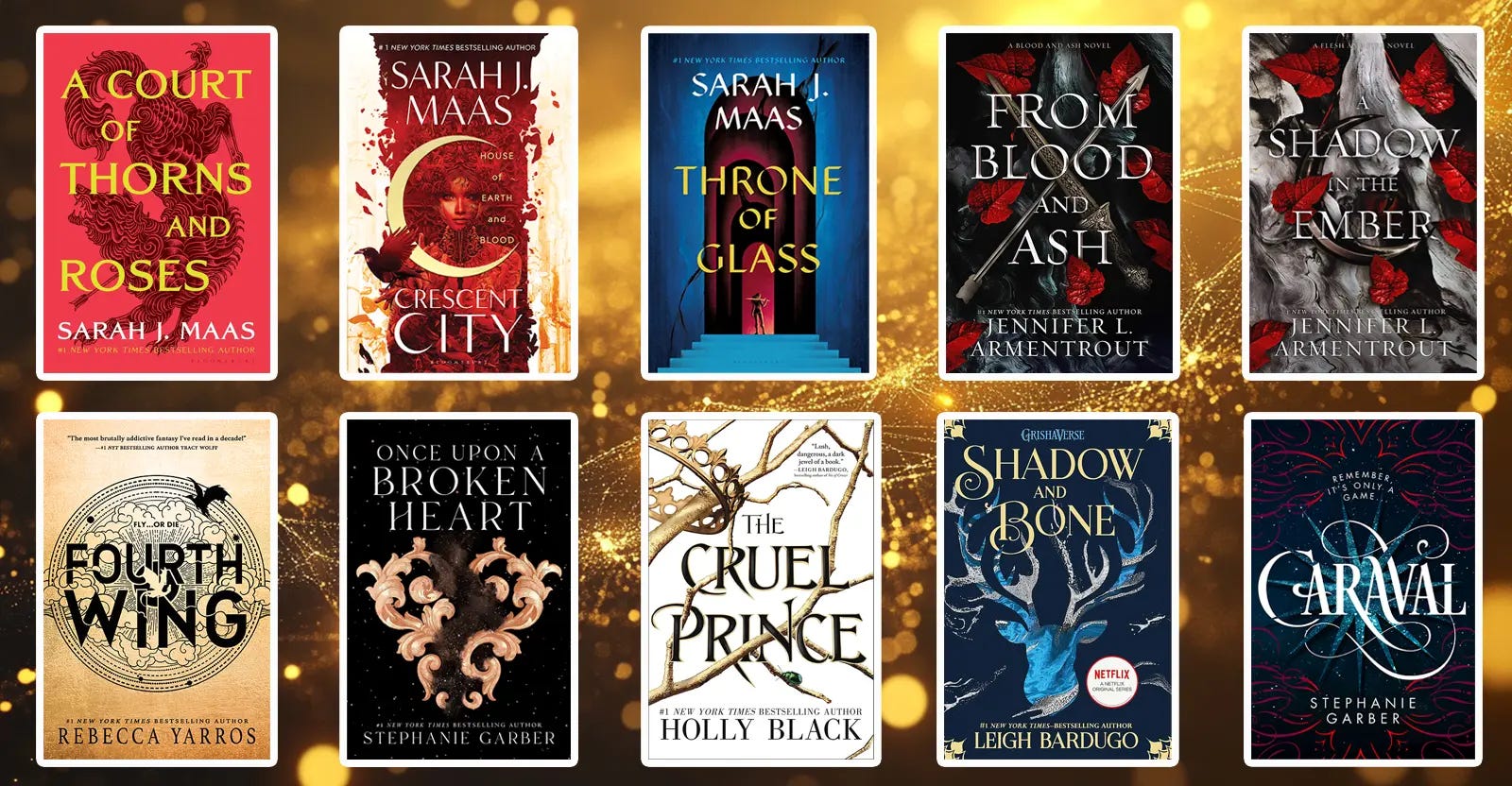
These books are popular for three reasons:
They offer an escape from this crazy world, placing you inside an even crazier world.
They offer a glimpse of a world that is possible. In these books, women are mainly the protagonists and therefore are often the heroes who defeat an evil empire. So while romantasy offers an escape, its themes are often heavy and mirror real-world problems.
Sometimes that escape includes a hunky warrior or prince with a tortured spirit, yet he somehow always knows the right things to say. I mean, why say “I love you” when you can say “By you, I am forever undone”?2 As I often tell my guy friends, if you want to understand what women want, read these books!
The Jewish world of Sarah J. Maas
The most popular series that’s often the gateway drug to romantasy is A Court of Thorns and Roses by Sarah J. Maas.


ACOTAR, as it’s known, is about a human woman named Feyre who gets taken by a half-beast, half-Fae man into his magical world. The first book is reminiscent of The Beauty and the Beast, but by the second book, the series diverts from the classic Disney tale. There’s war, adventure, romance/spice, you name it.
And it’s taken the literary world by storm! First published in 2015, the series has sold 13 million copies (and that’s not including Maas’s two other fantastic series). The newest ACOTAR book, the sixth installment, released last month and sold 1.7 million copies in a single day.3
There’s launch parties at Barnes and Noble, ACOTAR period underwear, and celebrities like Margot Robbie and Anne Hathaway who have professed their ACOTAR obsession. It’s the Maasverse and we’re all just living in it.
But what’s cool about this global phenomenon is that it weaves references to Judaism and Hebrew throughout the books, like:
One of the main characters is named Azriel, which is a Hebrew name meaning “G-d is my help.”
There are angels called Seraphim, which is also Hebrew and a kind of angel that appears in Isaiah. Side note: The angels in another Maas series, Crescent City, are called Malakim, Hebrew for angels. 👼
In the Fae world, a baby is officially presented to the world on the eighth day of their birth, similar to a brit milah.
The Fae world’s ancient book was written in a language called the Leshon Hakodesh, otherwise known as the Holy Tongue. You know in what other language this means holy tongue? Hebrew.
There’s a subplot involving a former slave named Miryam who escapes a parted sea before traveling through the desert. Sound familiar?
There’s another subplot where people leave lamb’s blood outside their doors after a powerful character searches the city for the king’s spies. They’re frightened of her power and leave blood as an offering for protection, giving total Passover vibes.
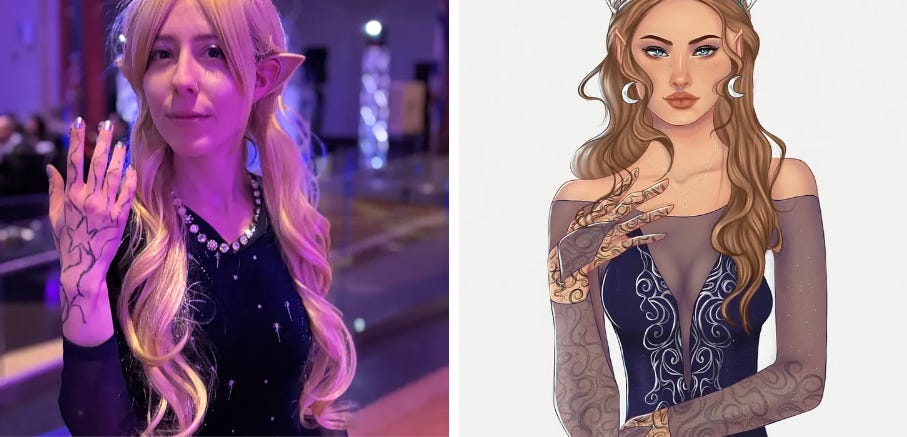
These books are full of matzo balls (my term for Jewish Easter eggs) because Sarah J. Maas is Jewish!
Growing up in New York with a Catholic mother and a Jewish father, Sarah spent her childhood attending Hebrew school, and later visited Israel on Birthright.
"The Wall on Shabbat was one of the coolest experiences, full of joy and energy. I left Israel overflowing with pride. It's a magical, welcoming place."
-SJM to The Jewish Chronicle4
Sarah’s connection to Judaism deepened in college. She attended Hamilton College where she met her future husband, Josh, who was president of Hamilton’s Hillel. Today, Sarah and Josh remain actively engaged in Jewish life as adults. For example, they have hosted a Passover Seder for Sarah’s grandmother.
Sarah’s grandmother, Camilla, is a Holocaust survivor and Sarah’s role model. Born in Frankfurt, Camilla was rescued by a Belgian Catholic family and eventually reached America. Camilla has volunteered with Sar-El, the Israel volunteer program I did last summer, 16 times!5
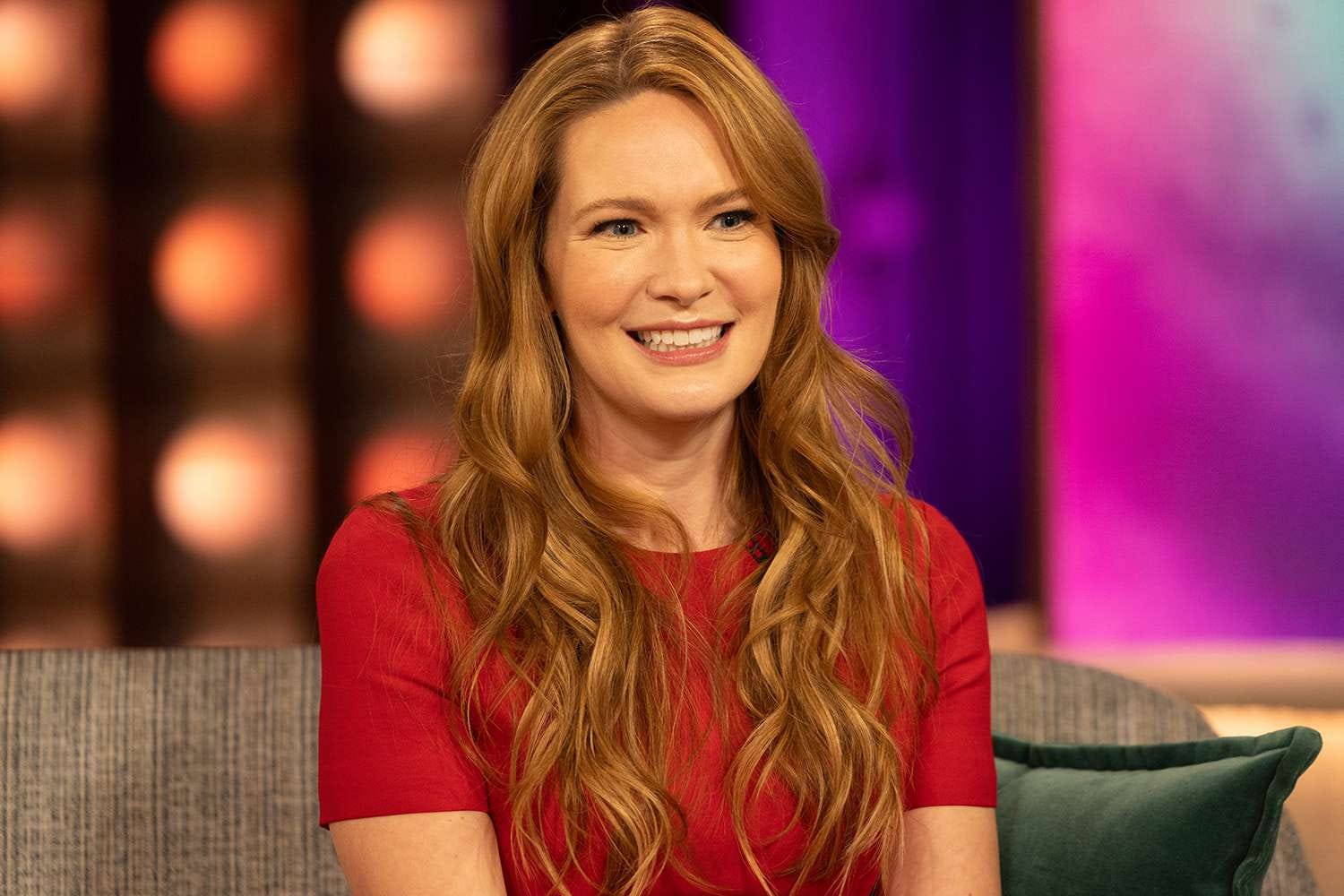
Complicit in genocide
Yup, that’s Sarah! Because writing about faeries (who are actually fighting against genocide) and finding it cool that Jews pray at a wall outside what’s left of their holiest site makes one complicit in genocide. 🙄
Sarah, like many other Jewish authors today, are targeted and blacklisted for “supporting the Zionist project.”6 Which honestly makes me chuckle because, as I said, Sarah J. Maas is one of the bestselling authors right now. So good luck to your boycott!
Antizionists also try drawing parallels between ACOTAR and the Israel-Palestine conflict.
Take, for example, a plotline in the second ACOTAR book, A Court of Mist and Fury, involving a place called the Hewn City.
Rhysand, High Lord of the Night Court, doesn’t allow the Hewn City, a court within the Night Court, to enter Velaris, a beautiful but hidden city within the Night Court. This is because the Hewn City is known for violence and cruelty, and he wishes to protect Velaris, the City of Starlight.
Some antizionist readers, mainly teenagers parroting buzzwords they hear, have drawn parallels between this fictional arrangement and Israelis and Palestinians. In their minds, Velaris is like Israel: a privileged, protected society, benefitting from the exclusion and confinement of their oppressed neighbors, i.e. Palestine.
If you believe this, please take a break from your fiction to read nonfiction! Also, if you believe the city associated with violence and cruelty represents Palestine, that’s on you.
I can relate to the urge to compare literature to Israel/Palestine. It’s hard not to, especially when the newest ACOTAR book involves political tension between the Fae “reclaiming their ancestral lands” where the humans now live, and the decision to build a wall between these warring peoples.
But then I remind myself it’s a book about faeries, and not every author’s fictional work is a reflection of their beliefs.
Sarah J. Maas isn’t the only blacklisted Zionist author in romantasy. Other popular authors like Rebecca Yarros, author of the dragon-centered Fourth Wing books, whose latest installment was the fastest-selling adult novel in 20 years7 and whose father is Jewish, has been called a genocide supporter for allowing her books to be translated to Hebrew shortly after October 7th. She defended her position on Instagram:
“To those tagging me and throwing around accusations that I support genocide, I will say this: As someone whose grandfather survived a Nazi concentration camp as a POW and suffered the lifelong physical effects of torture, I find your accusations not only false, but personally insulting. I abhor war in every form, which is why every military book I write delves into the myriad of ways war irrevocably harms people.” -Rebecca Yarros8
Some people are also troubled by the fact that Yarros comes from a military family, even though her books involve lots of sex at a military college. Make it make sense!
And finally, a man! Pierce Brown is the author of the popular sci-fi Red Rising books. While not romantasy, it’s worth sharing he received criticism for simply posting on Instagram about how October 7th was the deadliest day for Jews since the Holocaust. He’s not Jewish, just a writer with a heart.
I’m now off the romantasy derech, but let’s continue, shall we?
Another author placed on the “Is your fav author a Zionist?” boycott spreadsheet is the mainstream, Korean-Jewish Gabrielle Zevin, known for her book Tomorrow, and Tomorrow, and Tomorrow. This popular writer of literary fiction appeared at a Hadassah event, and made one of her characters in her famous book Israeli.9 I guess if the Israeli character were a settler colonialist it would have been fine!
The famous author R. F. Kuang is also in hot water for humanizing Israelis. She included an Israeli character in her newest book, Taipei Story, and faced backlash, even though she has supported BDS in the past.10
Jewish fantasy recs
There’s so much more romantasy to read, especially books with Jewish themes and books by Jewish authors! To end on an uplifting note, here are some fantasy reads every Jewish fantasy lover needs on their shelf. Happy reading!
Shabbat Shalom! Stay magical,

💦 If you like escapism, check out these Drops:
Revolts and Romance: Jewish Outlander Pt. I

What's Jewish about this steamy time-traveling romance? I compare the Jacobites' fight to preserve their identity and culture to the Maccabean Revolt.
Jewish Science Fiction and the Jewish Future

Hi! My name is Riv, and I am a writer based in Switzerland. I recently had a story published in the Jewish Futures anthology edited by Michael A. Burstein. This anthology contains futuristic stories with Jewish themes: from aliens seeking to convert to Judaism and then try to return to an abandoned Jerusalem on a deserted Earth, to baby robot golems.
The Queen of Nothing by Holly Black
I learned a lot from this one! Great piece! Funny how these hateful antisemites don't realize they're acting like orcs.
I love this drop! You seem not to be addicted to these books at all, nosiree nope not at all. 😉
Great piece. Shabbat Shalom!